
Your Grid-Tied Solar Shuts Off During Blackouts: Here's the Fix


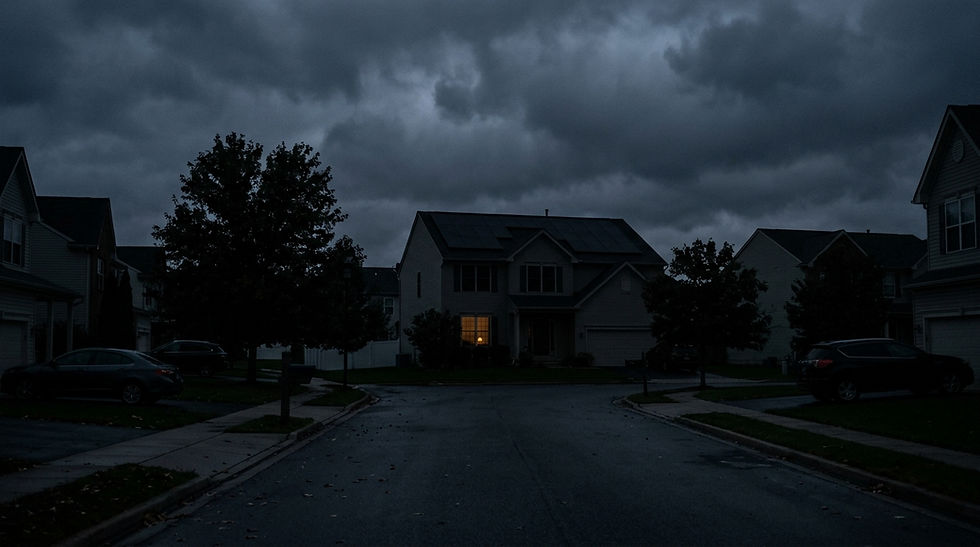
One of the most jarring moments in solar ownership happens during a power outage on a sunny day. Your panels are on the roof. The sun is out. And your house is completely dark.
Most homeowners assume something is broken. It isn't. Their system is working exactly as it was designed to work. And that's the problem — because nobody explained this before they signed the contract.
Why Your Solar System Shuts Off During an Outage

This isn't a malfunction. It's a federally mandated safety feature called anti-islanding protection.
Here's the reason it exists. When the grid goes down, utility workers go out to repair the downed lines. If your solar system kept feeding electricity into those lines during an outage, a worker touching a line they believed was dead could be electrocuted.
To prevent this, every grid-tied inverter in America is legally required to shut down the moment it loses the grid signal.
The result: your panels sit in full sunlight generating nothing useful while your fridge warms up, your phone dies, and your lights stay off. The panels aren't broken. The inverter isn't broken. The system is doing exactly what the law requires.
The traditional solution has always been a battery. The battery disconnects from the grid, forms its own electrical island, and your home runs off stored solar power until the grid comes back. Effective — but battery systems add $10,000 to $18,000 to a project cost. Not every homeowner is ready for that investment.
Which is why what Enphase built into the IQ8 microinverter matters.
What Is Sunlight Backup?

Enphase's IQ8 microinverter has a capability that older microinverters and standard string inverters don't have: it's grid-forming. During a daytime outage, instead of shutting off when it loses the grid signal, the IQ8 can form its own mini-grid and continue powering select circuits in your home directly from whatever your panels are producing at that moment. No battery required.
Enphase calls this Sunlight Backup.
Here's how it works in practice. You work with your installer to designate specific circuits as your backup loads — typically the fridge, lights, WiFi router, and a few outlets. Those circuits get wired to a dedicated backup panel. When the grid drops, the IQ8 microinverters detect the outage within about a minute, disconnect cleanly from the grid, and start powering those essential circuits directly from solar production.
The hardware required — an IQ System Controller, an IQ Load Controller, and a few supporting components — runs roughly $4,000 to $5,000 installed on top of your solar system cost. That's approximately one quarter of what a full battery system would add to your project.
The Honest Limitations
This is the part some installers gloss over, and it's important to understand before you decide.
It only works when the sun is shining. This is the most significant limitation. If your power goes out at 9 PM during a storm, Sunlight Backup provides zero protection. If it's heavily overcast all day, your backup loads may flicker or cut out entirely because there isn't enough solar production to sustain the microgrid. Enphase recommends keeping your designated backup loads under 30 percent of your total solar output to prevent the system from collapsing under cloud cover.
It doesn't handle high-draw appliances. Your central AC, electric water heater, and dryer pull far too much power for this system to support reliably without a battery stabilizing the output. Sunlight Backup is designed specifically for essentials — fridge, lights, WiFi, phone chargers.
SolarEdge cannot do this without a battery. If you have a SolarEdge string inverter system, there's no firmware update or add-on that provides this capability. SolarEdge's backup solution requires their Energy Hub inverter combined with a battery. If battery-free daytime backup is your goal, Enphase IQ8 is currently the only residential option that delivers it.
It's a middle ground, not a complete solution. For nighttime outages, multi-day storms, or reliable whole-home backup, you still need battery storage. Sunlight Backup is a meaningful step up from no backup at all — but it isn't a replacement for a full battery system.
Who Should Seriously Consider It

Sunlight Backup makes the most sense for three specific groups of homeowners.
Homeowners in areas with frequent daytime outages. Planned utility shutoffs, PSPS events in California, brief grid disturbances that typically resolve within hours — if your outages are measured in hours and tend to happen during daylight, Sunlight Backup covers most of your real-world scenarios at a fraction of the battery cost.
Homeowners who want resilience now with plans to add a battery later. The IQ8 platform is designed to be battery-ready from the start. When you're ready to upgrade, an Enphase IQ Battery integrates directly with the existing system. You're not starting over — you're adding to what's already there.
Homeowners who already have an Enphase IQ8 system that wasn't configured for Sunlight Backup. This is more common than you'd think. If your installer put IQ8 microinverters on your roof and never mentioned this capability, you may be able to add it without a significant system overhaul. Adding the IQ System Controller and Load Controller to an existing IQ8 installation is a relatively straightforward retrofit.
The Bottom Line
Your grid-tied solar shutting off during an outage is a solvable problem — and it doesn't always require a $15,000 battery system to solve it. Enphase's Sunlight Backup gives you meaningful daytime protection for roughly $4,000 to $5,000, with the option to expand into full battery backup later without replacing your existing equipment.
The key is starting with the right inverter. IQ8 microinverters give you this path. A standard string inverter or older microinverter system doesn't.
If you're not sure whether your current system supports Sunlight Backup — or whether it makes more sense for your outage risk and budget to go straight to a full battery system — that's exactly the kind of thing our free consultation is designed to figure out.


