
Is Dirty Panel Buildup Secretly Killing Your Solar Production?


Last month we pulled the monitoring data on a solar system in Texas. Two years old. Good panels, solid inverter, nothing broken. But production was down 22% from year one.
The homeowner thought his panels were degrading early. They weren't.
We asked him one question: "Have you ever cleaned your panels?"
His answer: "The rain takes care of it."
It doesn't. And what was sitting on his roof was costing him over $400 a year in lost production.
Why Dirty Panels Are So Easy to Miss
Unlike a dead microinverter or a failed string, dirty panels don't trigger an alert. Your monitoring app still shows green. Your system is technically "working." The production just quietly drops — month after month — and most homeowners chalk it up to seasonal weather variation.
It isn't weather. It's what's on your glass.
Rain handles dust reasonably well. It does not handle bird droppings baked in the sun. It doesn't dissolve tree sap. It doesn't remove lichen. And if you try to help by spraying tap water and letting it air dry, the dissolved minerals leave white residue that creates its own efficiency loss.
The result is a slow accumulation of multiple contamination types that compound over time — and a monitoring graph that looks like a gradual seasonal dip right up until the moment you realize it's been trending down for 18 months straight.
The 4 Types of Buildup That Do the Most Damage

1. Dust and Pollen
The most common and the most invisible. A thin film of dust doesn't look like much from the ground, but it blocks more light than you'd think. During spring pollen season, or in dry climates like Texas, Arizona, or parts of California, that layer builds up fast.
Research consistently shows dust buildup alone can reduce production by 5 to 15%. The loss is so gradual that your monitoring app just registers a slow downward trend — easy to mistake for seasonal variation until you're looking at a year of data and wondering where your output went.
2. Bird Droppings

Worse than dust per square inch — significantly worse. A single bird dropping doesn't just block the light on the spot it covers. It creates what's called a hot spot.
The cells underneath that dropping can't produce power, but current from the rest of the panel still flows through them. That mismatch generates heat. Over time, it can permanently damage the cells. On a string inverter system, one dropping on one panel can drag down the output of every other panel wired to that string.
If birds frequent your roof and you don't have critter guards installed, this is worth checking regularly — it's not just cosmetic.
3. Tree Sap
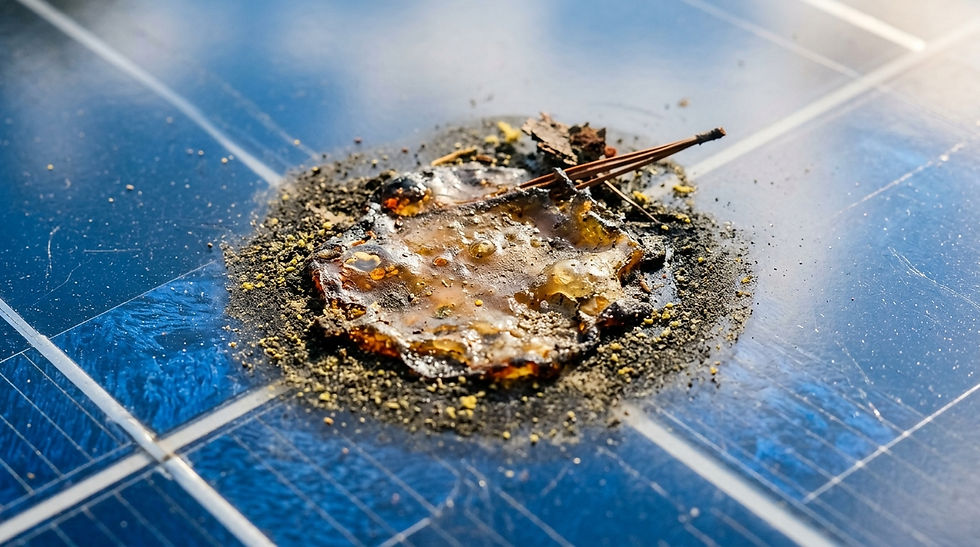
This one is nasty because rain won't touch it.
If you have pine trees or other sap-producing trees near your array, sap drips onto the panel surface and bakes in the sun. Once it cures, it's essentially glue. Dust and pollen then stick to the sap, compounding the blockage. You end up with patches of sticky, opaque buildup that are far more damaging than regular dust — and completely immune to rainfall.
Tree sap requires manual cleaning. And this is exactly where tap water creates a second problem: let it air dry in the sun and the dissolved minerals leave white mineral spots that add their own layer of efficiency loss. Waterless or deionized water methods are the smarter approach.
4. Lichen and Moss

This one is specific to humid climates — Florida, the Carolinas, parts of the Pacific Northwest. If panels are in a shaded or partially shaded area with high moisture, organic growth can take root on the panel frame and edges and gradually creep onto the glass itself.
Once lichen or moss is established, it's extremely difficult to remove without damaging the anti-reflective coating on the panel surface. If you see green or gray patches on your panels that don't look like regular dirt, do not try to scrub it off yourself. This is the one contamination type where DIY cleaning can make things worse. Call a professional.
How to Clean Panels Without Water (3 Methods)
Method 1: Soft-Bristle Brush
The simplest and most accessible option for regular maintenance. Get a telescoping pole with a soft nylon or boar-hair brush head — you can reach most single-story roofs from the ground.
Light sweeping strokes only. No pressure, no scrubbing. Solar panels have an anti-reflective coating that scratches if you push too hard, and scratches are permanent production losses. Do this every three to four months, or right after pollen season.
Method 2: Microfiber Cloth With Panel-Safe Spray
For bird droppings and tree sap, a dry brush won't cut it. Use a damp microfiber cloth with a solar-panel-specific cleaning spray — these are formulated to dissolve organic residue without damaging the coating.
Never use Windex, dish soap, or household cleaners. The surfactants and chemicals in standard cleaners can degrade the anti-reflective coating over time, which is a permanent hit to your production.
Method 3: Robotic Cleaners
If you want completely hands-off maintenance, lightweight waterless cleaning robots are now available for residential arrays. They typically weigh around 13 pounds, use dry brushes with suction to clean one panel at a time, and cost a few hundred dollars.
Overkill for most homeowners — but genuinely useful if you have a large array, mobility limitations, or a steep roof pitch that makes manual cleaning difficult or unsafe.
The 15% Rule: When to Stop DIYing and Call a Pro
A basic brush cleaning handles most routine dust and pollen buildup. But if your production is still down 15% or more after a thorough cleaning — and you've confirmed it's not a monitoring connectivity issue — something deeper is going on.
Lichen and moss always warrant professional assessment before any cleaning attempt. And if you're not sure whether your production drop is caused by dirt, shading changes, or a hardware issue, those symptoms look identical from the monitoring app. A remote data review can usually differentiate them in about ten minutes.
Don't Let $400 a Year Disappear Quietly
The Texas homeowner from the start of this post wasn't unusual. We see versions of his situation regularly — systems producing 15 to 25% below potential with no error codes and no obvious symptoms. The monitoring shows green. The panels look okay from the driveway. And hundreds of dollars in annual production quietly disappear.
A soft brush and 20 minutes every few months is all it takes to prevent most of it.
If you're not sure whether your production drop is a cleaning issue or something more serious, we can review your monitoring data remotely and tell you in about ten minutes. Free, no pressure.


