
Is Solar Worth It in 2026 Without the Tax Credit? The Line Moved...


A $25,000 solar system did not suddenly become 30% less productive on January 1, 2026.
It became $7,500 harder to justify.
For qualifying homeowner-owned systems installed through the end of 2025, the federal Residential Clean Energy Credit could equal 30% of eligible costs. For new residential clean-energy expenditures after December 31, 2025, Section 25D no longer provides a new federal credit.
That matters. A lot.
But losing the credit does not answer whether solar is worth buying in 2026.
It changes the number solar has to beat.
And now that the 30% cushion is gone, system price, financing, your utility rate, export compensation, and actual solar production matter more than ever.
Did the 30% residential solar tax credit really end in 2026?
Yes.
The IRS says the Residential Clean Energy Credit under Section 25D is not available for new qualifying expenditures made after December 31, 2025. Solar panels and qualifying battery storage were among the technologies previously covered.
There was no gradual homeowner phase-down into 2026.
And signing a contract or paying for a system in 2025 does not preserve the credit if installation is completed afterward. The IRS says an expenditure for this purpose is treated as made when the item's original installation is completed. So a system completed after December 31, 2025 does not qualify merely because money changed hands earlier.
One important exception to the “zero in 2026” shorthand: if you legitimately earned a Residential Clean Energy Credit in an earlier year and could not use all of it because of the tax-liability limitation, prior-year credit may carry forward. The IRS's 2025 Form 5695 specifically includes a line for a Residential Clean Energy Credit carryforward into 2026.
That is different from receiving a new credit for a system installed in 2026.
This article provides general information, not individual tax advice. Tax treatment can depend on your circumstances, so confirm your situation with a qualified tax professional.
The old 30% credit was not literally “30% off”
This distinction matters when comparing old and new solar quotes.
The former residential credit was nonrefundable. It reduced federal income-tax liability; it was not automatically a check for 30% of the contract price. Eligible unused amounts could generally be carried forward. The IRS also excludes items such as loan interest and loan-origination fees from qualifying costs.
So a salesperson saying:
“This $30,000 system really costs $21,000.”
was always simplifying.
The more accurate statement was:
“If $30,000 of costs qualify and you are eligible to realize the full credit, the potential federal credit is $9,000.”
In 2026, a newly installed homeowner-owned residential system gets no new Section 25D credit.
That difference should now be visible in every serious solar calculation.
How much does losing the tax credit change solar payback?

Consider a hypothetical system.
Cash price: $25,000Estimated first-year electricity value: $2,000
Ignore financing, degradation, maintenance, future utility-rate changes and other incentives for a moment.
Under the old 30% credit, assuming the entire $25,000 qualified and the homeowner ultimately realized the full credit:
$25,000 × 30% = $7,500 potential federal credit
Effective cost after that credit:
$25,000 − $7,500 = $17,500
Simple payback:
$17,500 ÷ $2,000 = 8.75 years
Now install the same system in 2026:
Federal homeowner credit = $0
Simple payback:
$25,000 ÷ $2,000 = 12.5 years
Same panels.
Same roof.
Same electricity production.
But losing the federal credit adds almost four years to simple payback in this hypothetical.
That is what “the line moved” actually means.
It does not mean every solar project became bad.
It means projects that were only marginally attractive with a $7,500 federal benefit may no longer survive without it.
So what determines whether solar is worth it in 2026?

Start with the value of the electricity the system actually produces.
A useful simplified calculation is:
Annual solar value =
self-consumed solar kWh × electricity cost avoided
+
exported solar kWh × utility export credit
Then compare that value with what you're actually paying for the system.
For cash buyers, the system's cash price is the obvious starting point.
For financed buyers, do not substitute the advertised monthly payment for system cost.
Compare:
the cash price;
amount financed;
APR;
financing or dealer fees;
loan term;
total of all payments;
projected annual electricity value.
The CFPB has warned that some solar-specific financing products have included substantial fees above a system's cash price and that financing costs can wipe out expected savings.
That comparison is even more important now that homeowners cannot assume a future 30% tax benefit will be available to make a large loan prepayment.
What makes a strong 2026 solar case?

Solar has a stronger financial case when the home combines several advantages: a productive roof, a competitive installed price, meaningful electricity consumption, a high avoidable utility rate, favorable compensation for exported electricity, low-cost financing or cash ownership, and enough expected time in the home to recover the investment.
Utility policy matters enormously because exported solar is not valued the same way everywhere. Net-metering and export-compensation rules depend on the state and utility.
Electricity prices also vary significantly by location. The U.S. residential average was 18.44¢/kWh in May 2026, 6.2% higher than May 2025, but a national average should not be used to calculate savings for an individual home. Your utility tariff is the relevant number.
That is why “Is solar worth it in America in 2026?” has no honest universal yes-or-no answer.
Who has a weaker solar case without the credit?

I would not use a blanket rule such as:
“If your bill is below $100, solar isn't worth it.”
A small electric bill may mean there is simply less spending available to offset—but that does not establish the economics by itself.
The weaker cases are usually combinations of problems:
A roof with significant shade.
A roof needing replacement soon.
A high installed price.
Expensive financing.
Large fixed utility charges that solar cannot eliminate.
Poor export compensation combined with low daytime self-consumption.
A short expected ownership period.
Or a proposal whose savings depend on aggressive assumptions about future utility-rate increases.
Without the federal homeowner credit, there is simply less room for one weak assumption to hide behind another.
If the project only works when electricity prices rise 5% every year, every exported kilowatt-hour receives full retail value, and the homeowner stays for 25 years, the proposal does not have much margin for error.
Not sure whether the numbers in your 2026 proposal actually work? Get an IntegrateSun quote review based on your roof, utility and financing—not an assumed federal credit.
Can you still get the 30% federal credit through a solar lease or PPA?
This is where a lot of 2026 explanations have become outdated.
A homeowner who leases solar panels does not claim the old Section 25D residential credit because the homeowner does not own the system.
But it is also no longer accurate to simply say:
“Don't worry—the leasing company gets the 30% commercial credit instead.”
Section 48E, the Clean Electricity Investment Credit, still exists for qualifying taxpayers and projects, but its treatment of residential third-party solar changed. Current IRS Form 3468 instructions state that for tax years beginning after July 4, 2025, no credit is allowed for solar-electric property if the taxpayer rents or leases that property to a third party during the tax year.
PPAs are structured differently from equipment leases, and federal tax eligibility can depend on the specific ownership and contractual structure. Section 48E also now has accelerated timing rules for applicable wind and solar projects: projects subject to the new rules that begin construction after July 4, 2026 generally must be placed in service before 2028 to remain eligible, alongside other current eligibility restrictions.
For a homeowner, the practical takeaway is simpler:
Do not assume a lease or PPA automatically preserves a 30% federal solar incentive.
Ask the provider:
Are you claiming a federal tax credit on this specific project? Which credit? And is that benefit reflected in the price I'm being offered?
Then evaluate the contract on its own economics.
The CFPB notes that leases may contain annual payment increases, while PPAs may include contractual price escalators and can run for many years.
Compare the total expected contract payments, not only the first month's payment.
Does a solar battery still make sense without the 30% homeowner credit?
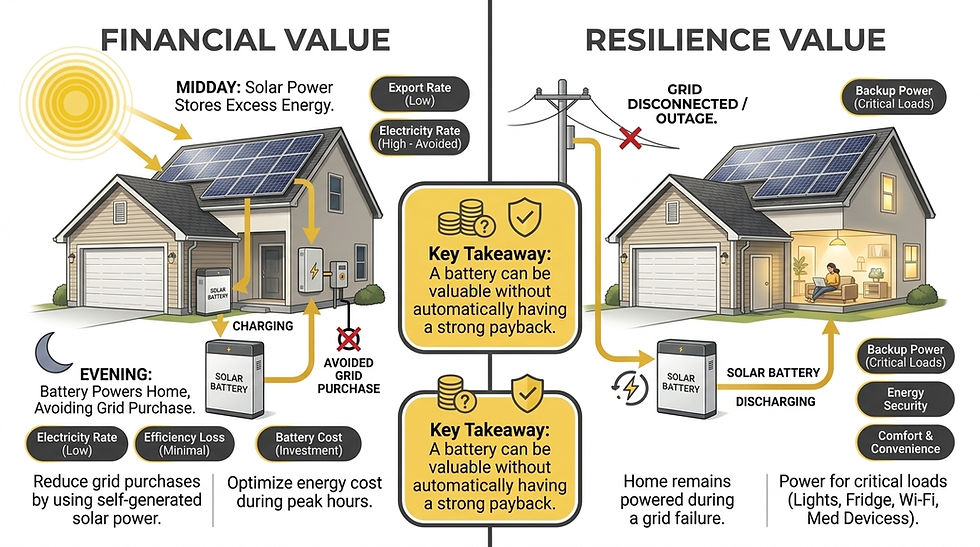
A homeowner-installed battery also lost access to new Section 25D credits after December 31, 2025. Battery storage had been an eligible technology under the residential credit.
That makes the battery's standalone economics more important.
A battery can create value in several different ways:
It may provide backup power.
It may shift solar energy from midday into expensive evening periods.
It may increase self-consumption where utility export compensation is poor.
It may also participate in certain utility programs where available.
But those benefits have to be measured against the battery's full installed cost, efficiency losses, degradation and expected life.
Do not assume:
“Net metering is weak, therefore I need a battery.”
Run solar without storage first.
Then calculate exactly how much additional annual value the battery creates.
Backup power may still be worth paying for even when the battery does not generate a compelling financial return—but that is a resilience decision, not the same thing as payback.
Should you wait for the federal residential solar credit to come back?
There is currently no scheduled return of Section 25D for new residential expenditures. The current law terminated the credit after December 31, 2025.
Could Congress change the law again someday?
Of course.
But building a 2026 household investment decision around legislation that has not been enacted is speculation.
The same caution applies in the other direction.
Do not automatically assume utility electricity prices will rise by a particular percentage every year just because prices have increased recently. National residential electricity prices were higher year over year in May 2026, but future changes vary by utility, fuel costs, regulation and region.
Model the project under today's rules.
Then stress-test the assumptions.
So, is solar worth it in 2026 without the tax credit?
Sometimes clearly yes.
Sometimes clearly no.
And compared with 2025, there are more homes in the middle.
The federal credit used to absorb a substantial portion of qualifying homeowner cost. Without it, a project needs more of its value to come from the fundamentals:
competitive price + good production + valuable electricity offset + sensible financing + enough time
That is not bad news or good news.
It is simply a higher hurdle.
So before signing a 2026 solar proposal, don't ask only:
“How much is my monthly payment?”
Ask:
What is the cash price?What will I pay if I finance it?How much electricity will it produce?How much of that electricity will I use myself?What does my utility pay for exports?And how many years does the project take to recover its real cost—with no federal homeowner credit assumed?
If those numbers still work, solar did not need the tax credit to rescue the deal.
If they do not, the answer isn't to massage the assumptions until they do.
It's to walk away.


