Does Solar Increase Your Property Taxes in Texas? Here's the Law.

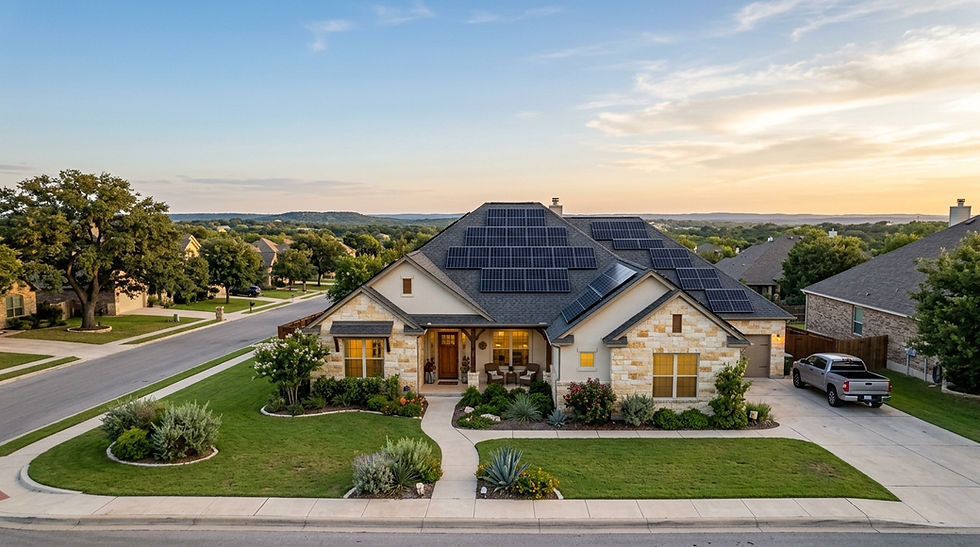
It's one of the most common fears Texans have about going solar: panels raise your home's value, higher value means higher property taxes, so you get punished for going green. It's a reasonable worry. It's also, in Texas, exactly backwards — and there's a specific law that proves it.
Does installing solar increase your property taxes in Texas?
No. Texas law gives you a 100% property tax exemption on the added home value that solar creates. Under Texas Tax Code §11.27, if solar raises your home's appraised value by $20,000, that entire $20,000 is exempt from property tax. You're taxed as if the equipment isn't there.
So the fear has the mechanics right but the outcome wrong. Solar does raise your home's market value — studies consistently show solar homes sell for more. What Texas does is let you capture that higher value when you sell, without paying a nickel of extra annual property tax while you own it. You get the upside and skip the downside. That's rare in tax law, and most Texans have no idea it exists.
How much does the Texas solar property tax exemption actually save?

On a typical $23,500 system at an average Texas county tax rate of around 2.2%, the exemption saves roughly $500 a year — and $10,000 to $13,000 over 25 years. The exact number depends on your county's rate and how much value your appraisal district assigns to the system.
Texas has some of the highest property tax rates in the country, which is exactly why this exemption matters more here than it would almost anywhere else. In a state with no income tax, property tax is the tax — so an exemption that removes solar from that bill is genuinely meaningful money, not a rounding error.
Is there a catch? Yes — you have to file for it.

The exemption is not automatic. You must file Form 50-123 ("Application for Solar or Wind-Powered Energy Device Exemption") with your county appraisal district — not the IRS, not the state — by April 30 of the tax year. Miss it, and you can end up paying property tax you never owed.
This is the part that quietly costs people money. The good news travels — "Texas exempts solar from property tax!" — but the filing requirement doesn't. So homeowners assume it's handled, never file the one-page form, and get appraised on the added value anyway. If you already have solar and never filed Form 50-123, there's a real chance you're overpaying right now.
Here's how it works, start to finish:
Download Form 50-123 from the Texas Comptroller's website.
Fill in your property details, system size, install date, and installer info.
File it with your county appraisal district between January 1 and April 30 of the tax year.
Once approved, it stays in place as long as the system is installed and operational — no annual renewal.
One thing worth knowing about the exact process for your county is that appraisal districts vary in how they assess the added value in the first place — which is a detail worth confirming locally. If you want a hand making sure you don't leave this money on the table, a free consultation with IntegrateSun covers the exemption and the paperwork as part of planning your system — not as an afterthought once you're already appraised.
Does the exemption apply if I lease my solar panels?

Not to you. If you lease your panels or use a power purchase agreement, the leasing company owns the equipment — so they file for the exemption, not you. The exemption follows ownership. This is one more reason to understand exactly how you're acquiring a system before you sign, because who owns the panels changes who claims the tax benefit.
For a homeowner who buys (cash or loan), you own the equipment and you file. For a lease or PPA, you don't own it, so this particular benefit isn't yours to claim — worth factoring into the true cost comparison between buying and leasing.
Why this matters more in 2026 than it used to
With the federal residential solar tax credit (Section 25D) expired as of December 31, 2025, a cash or loan solar buyer gets $0 back from the IRS in 2026. That makes state and local incentives more important than they've been in years — and in Texas, this property tax exemption is now one of the primary remaining incentives for residential solar, alongside utility buyback programs.
Texas also has no state income tax, which means no state solar income-tax credit exists either. So the incentive picture in Texas 2026 comes down to two things: your utility's buyback plan, and this property tax exemption. Both are worth getting right, and both are easy to leave on the table if nobody walks you through them.
The bottom line for Texas homeowners

Solar will not raise your property taxes in Texas; the added value is 100% exempt under Tax Code §11.27. But the exemption only works if you file Form 50-123 with your county by April 30. The technology is protected by law; the paperwork is on you.
So the honest answer to "does solar increase my property taxes in Texas" is: no, not if you file the form. And that one form is the difference between the law working for you and quietly working around you.
Get it done right from the start
The cleanest way to handle this is to plan for it before you install, not scramble after your next appraisal. A free IntegrateSun consultation includes your Texas-specific incentive picture — the property tax exemption, the Form 50-123 filing, and your utility's buyback options — so nothing that's rightfully yours gets left unclaimed.
No pressure. Just the full picture, Texas rules included.