
Is a Bigger Solar Battery Better? Find the Bottleneck Before You Buy the Box

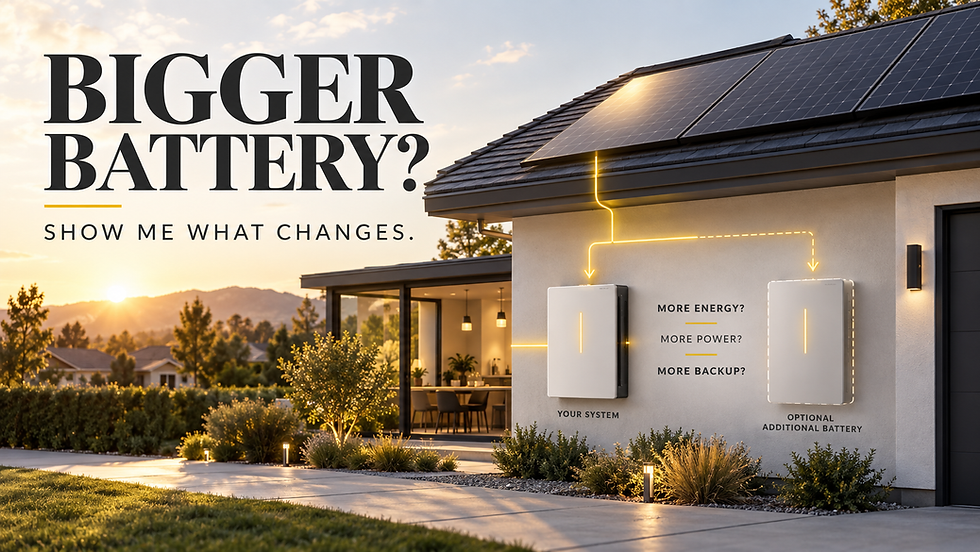
A second battery can add thousands to a quote — sometimes well over ten thousand. So when a proposal jumps from one battery to two, your thought process shouldn't be "is a bigger battery better?" Instead, it should be "what exactly is the second one doing for me?"
Thankfully, there are good answers to that. Talking of; longer outage coverage, more evening energy shifted off peak rates, enough power to actually run your AC during a blackout, making use of solar you'd otherwise export for pennies. And then there's the one that sounds the most scientific — "a bigger battery won't cycle as deeply, so it'll last longer" — which has real science behind it and still usually isn't a reason to buy one. Here's how to tell the difference.
Is a bigger solar battery better?
Only if the extra capacity is doing a job you actually have. And there are two different jobs it could be doing, which is where most of the confusion starts.
For bill savings, unused capacity doesn't earn much. If you install 30 kWh but your rate strategy only moves 10 kWh through it on a normal day, the idle portion isn't producing the same return as the part doing daily work. For backup, it's the opposite — reserve capacity that rarely discharges can still be exactly what you're paying for, the same way insurance you don't claim isn't wasted money. If you're buying another eight hours of outage coverage because that matters to your household, the reserve is the product.
So before you decide a battery is "too big," separate the two: what financial job is the extra capacity doing, and what resilience job is it doing? If both answers are vague, that's when to push back.
Do I need more kWh, or more kW?

This is the question almost nobody tells homeowners to ask, and it changes the whole conversation. kWh is how much energy the battery stores — how long it runs your house. kW is how much power it can deliver at once — what it can run simultaneously. They're not interchangeable, and "add another battery" might be solving either one.
Real products make the gap obvious. An Enphase IQ Battery 5P delivers about 3.84 kW continuous per unit; a Tesla Powerwall 3 is around 11.5 kW; a FranklinWH aPower 2 around 10 kW. That's a three-fold difference in what they can run at the same moment, separate from how much they store. If your battery has plenty of stored energy but trips when the AC compressor kicks on, that's a power problem, and more kWh of the wrong product won't fix it.
So when an installer recommends another battery, ask: what constraint are we fixing — stored energy, output power, or both? If nobody can answer that, "two batteries" isn't a design yet.
👉 Got a quote with a second battery on it and no explanation? Send it over — we'll tell you what it's actually solving.
Does a bigger battery actually last longer?

Potentially — but "bigger equals longer life" is too simple, because batteries age two different ways at once. Cycle aging happens as energy moves in and out. Calendar aging happens with time, even sitting idle.
Depth of discharge does affect cycle aging, and spreading the same daily load across a larger battery means shallower cycles. But how much that actually buys you depends on chemistry, cell design, temperature, charge rate, and where in the state-of-charge range the cycling happens — research on commercial LFP cells doesn't support translating "shallower cycle" into one universal life extension. And calendar aging pushes the other way: studies of LFP cells show elevated temperature and long periods at high state of charge increase capacity loss, with temperature often the bigger driver.
The honest version: a larger battery can cycle more gently, and if it also spends long stretches sitting near full in a hot garage, some of that gain goes back. Whether it nets out in your favor depends on your actual operating profile — how the system is configured, your reserve setting, how much surplus solar you have. Nobody can hand you a number for that off a spec sheet, and anyone who does is guessing.
What does the battery warranty actually tell me?
Something genuinely useful — just not the answer to sizing. The warranty tells you which kind of aging the manufacturer is willing to stand behind, and that's the fastest way to test a longevity pitch.
Say someone argues you need more capacity to preserve your cycle count. Check the document. Enphase's IQ Battery 5P is covered to the earlier of 15 years or 6,000 discharged cycles — and 6,000 cycles at roughly one a day is about 16.4 years, so the 15-year term would land first. That's a concrete thing to point at: under that usage, preserving cycles wouldn't extend the coverage period. (It doesn't prove two differently-sized batteries will have identical capacity at year 15 — a warranty is a coverage promise, not a physics model. It just means the cycle-preservation argument isn't buying you warranty.)
And there's no universal structure to assume. Tesla's Powerwall pairs a shorter 10-year term with very permissive usage language — unlimited cycles for the ordinary residential uses. FranklinWH's aPower 2 runs 15 years or 60 MWh of throughput. Generac's PWRcell 2 uses 10 years with a throughput cap per module. Even the capacity-retention floor differs — some guarantee 70% remaining at term's end, others 60% — so the longest term isn't automatically the strongest guarantee. Find out what actually limits yours — time, cycles, throughput, use type, retention floor — then ask whether the extra battery changes that limit in any way that matters. And pull the current document; these get revised.
More panels or a bigger battery?
Don't start with the product — find the bottleneck. If your battery rarely reaches full charge, another battery just buys you more empty capacity; you need more generation or a different operating strategy. If it's full by midday and you're exporting cheap surplus all afternoon, then running empty during expensive evening hours, that's a genuine storage constraint.
And if it holds plenty of energy but can't run the loads you care about together, that's the kW problem again, not a kWh problem. There's no universal winner between panels and batteries — there's whichever one is actually limiting you.
How do I tell an upsell from a real recommendation?

Ask to see the system modeled both ways — with one battery and with two — and not just the price difference. You want the difference in annual energy shifted through storage, expected bill savings, solar that would otherwise be exported, backup runtime on the loads you actually care about, and available continuous power.
If the second battery adds real savings, solves a defined backup target, or provides power the first configuration can't, there's an engineering case and you'll see it in those numbers. If the explanation stops at "more backup is better," there isn't one yet.
The bottom line
Bigger isn't automatically better and it isn't automatically a scam. Extra capacity needs either a financial job or a resilience job worth paying for — and which one you're buying changes how you judge it. The longevity argument is real but soft, the warranty tells you what's limited rather than what to buy, and kWh and kW are different problems.
So find the bottleneck first. Then make whoever's quoting you show what the extra battery changes — in kWh moved, kW available, dollars saved, and hours of backup. That's how you tell deliberate design from an expensive second box on the wall.
👉 Get a free IntegrateSun storage review — send us the quote and we'll model what the additional capacity actually changes before you pay for it.


