
Is the Inverter in Your Solar Quote Too Small? Here's How to Check Before You Sign


Your solar quote says 430-watt panels.
Then you look up the microinverter and discover that it can continuously output only 290 VA.
Did your installer just pair an expensive high-output panel with an inverter that cannot use all of its power?
Maybe.
But the answer is not as simple as comparing 430 to 290.
Solar panels are rated under laboratory test conditions, and rooftop panels spend much of the year producing below their nameplate wattage. That is why designers routinely pair an array with less AC inverter capacity than its total DC panel rating.
The practice is called inverter loading, or DC-to-AC oversizing.
Some clipping can be completely normal.
The real question is:
How much energy will this inverter actually clip over a year—and would paying for a larger inverter recover enough additional energy to justify the cost?
That's what you should check before signing.
What is solar inverter clipping?

Solar panels produce DC electricity. Your inverter converts that electricity into AC power your home and the grid can use.
Every inverter has a maximum amount of power it can output.
If your panels are capable of supplying more usable power than the inverter can convert at that moment, the inverter limits its output. On a production graph, this can create the familiar flat top called clipping.
For example, the Enphase IQ8+ has a maximum continuous output of 290 VA at 240 V. The older IQ8M is rated at 325 VA, IQ8A at 349 VA and IQ8H-240 at 380 VA.
So yes: a sufficiently productive panel paired with an IQ8+ can at times produce more available DC power than the microinverter can convert.
But that alone does not mean the system was designed badly.
Why would an installer intentionally use a smaller inverter?
Because your panel's nameplate wattage is not its normal all-day output.
A 430W module receives that rating under Standard Test Conditions. Real rooftop output varies with factors such as:
sunlight intensity
panel temperature
roof direction
roof pitch
shading
weather
soiling
wiring and conversion losses
module degradation
That means a 430W panel does not sit at 430W from morning through afternoon.
If you bought an inverter large enough to accommodate the panel's theoretical maximum with virtually no clipping, you could pay for inverter capacity that is rarely used.
A somewhat smaller inverter may reach an efficient operating range earlier in the day and remain there longer while sacrificing only a small amount of energy during the strongest production periods.
Enphase's own technical guidance shows this tradeoff: increasing the DC-to-AC ratio can increase clipping, but the larger module can still produce more total AC energy. The amount of clipping also changes with location and declines over the system's life as modules degrade.
So clipping is not automatically a design defect.
Excessive clipping is what you need to investigate.
How do I check the inverter-to-panel ratio in my solar quote?
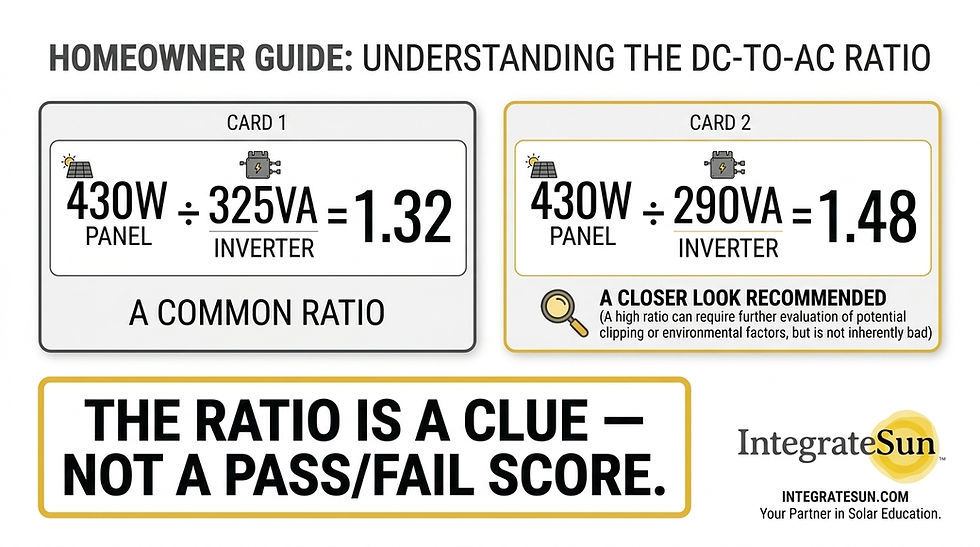
You can perform a useful first check in less than a minute.
Find:
The wattage of one solar panel.
The inverter's maximum continuous AC output.
Then divide:
Panel DC rating ÷ inverter continuous AC output
Suppose your proposal uses a 430W panel.
430W panel with Enphase IQ8M
The IQ8M has a maximum continuous output of 325 VA.
430 ÷ 325 = 1.32
That is a DC-to-AC ratio of approximately 1.32.
430W panel with Enphase IQ8+
The IQ8+ has a maximum continuous output of 290 VA.
430 ÷ 290 = 1.48
The second design has substantially more DC panel capacity relative to its inverter capacity, so it has more potential to clip.
But do not make the mistake of concluding:
1.32 = good and 1.48 = bad.
The ratio tells you which proposal deserves closer examination.
It does not tell you the annual clipping loss.
What is a good DC-to-AC ratio for solar?
There is no universal number that makes a residential solar system good or bad.
You will often see ratios around 1.2 discussed in solar modeling, and systems are routinely designed with DC capacity above AC inverter capacity. NREL likewise treats inverter loading ratio as an important system-design and energy-modeling variable.
But an acceptable ratio depends on the actual system.
Consider two identical 430W panels.
One faces south on an unshaded roof in an area with strong solar irradiance.
The other faces west, runs hotter and receives less peak midday irradiance.
Pair both with the same inverter and their clipping behavior can be different.
Arrays split across east- and west-facing roof planes can also behave differently from an ideal south-facing array because all panels are not reaching their maximum production at the same time.
That is why we would not reject a quote simply because its ratio is 1.4, 1.45 or even higher.
We would ask what that ratio does to annual production.
How much inverter clipping is too much?
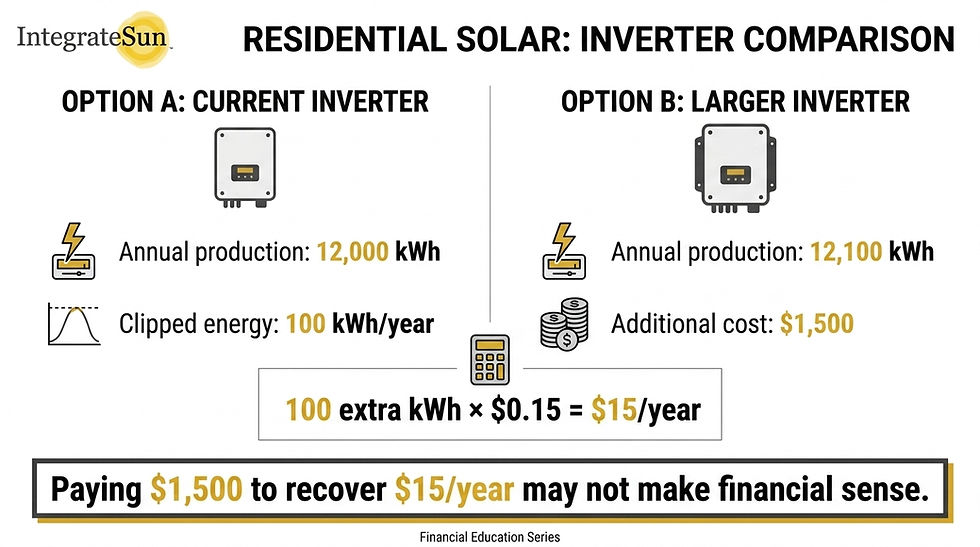
This is the better question.
Ask the installer to model the expected annual production with the proposed inverter and then compare it with the next appropriately sized inverter.
For example:
Design A
Expected annual production: 12,000 kWh
Expected clipping: 100 kWh
Design B with larger inverters
Expected annual production: 12,100 kWh
Additional inverter cost: $1,500
The larger inverter recovers only 100 kWh per year.
If each additional kilowatt-hour is worth 15 cents to you:
100 × $0.15 = $15 per year
Paying another $1,500 to recover $15 per year would make little financial sense.
Now change the example.
If the proposed inverter is expected to sacrifice 800 kWh annually and a modest inverter upgrade recovers most of it, that deserves a much closer look.
This is why “Does it clip?” is the wrong question.
Most homeowners should ask:
How many annual kilowatt-hours are being clipped, what are those kilowatt-hours worth, and how much would it cost to recover them?
Is a 430W panel too large for an Enphase IQ8+?
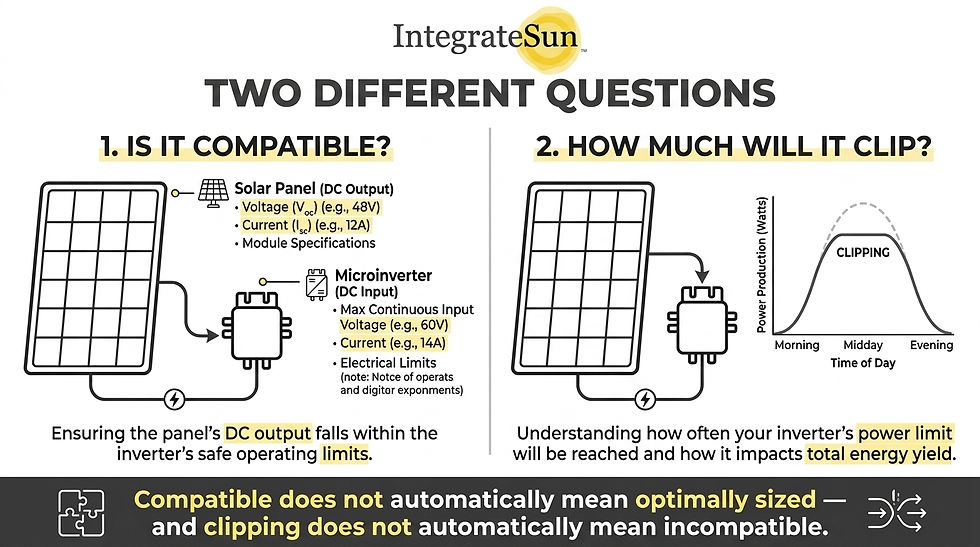
Not automatically.
The Enphase IQ8+ has 290 VA of maximum continuous output at 240 V, so a 430W module creates a nameplate DC-to-AC ratio of approximately 1.48. Enphase lists the IQ8+ with an input-power range extending as high as 440W.
But neither of those numbers tells you the complete answer.
First, verify that the exact module is electrically compatible with the exact microinverter.
That requires checking more than wattage. Module voltage, current and temperature characteristics matter.
Enphase provides a module compatibility calculator for this purpose—and importantly, Enphase states that the calculator determines compatibility but does not calculate the clipping that may occur with a particular pairing.
That gives homeowners two separate questions:
1. Is this panel electrically compatible with this microinverter?
2. If it is compatible, how much annual energy will this specific pairing lose to clipping?
Do not let those two questions get confused.
Which Enphase microinverter should go with my solar panel?
Be skeptical of any chart that says something like:
“300–350W panels need IQ8+.”
“400–450W panels need IQ8M.”
It is not that simple.
Enphase currently offers multiple IQ8-family microinverters with different output ratings and electrical operating ranges. U.S. models include products such as the IQ8+, IQ8MC, IQ8AC, IQ8HC and higher-powered IQ8P, among others. For example, the IQ8MC is rated at 320 VA continuous output at 240 V, the IQ8AC at 349 VA and the IQ8HC at 380 VA.
The right pairing depends on the exact module and system design—not panel wattage alone.
That is why your installer should be able to provide both the manufacturer compatibility check and the production model used to select the inverter.
Does clipping mean I'm wasting money on high-wattage panels?
Not necessarily.
Suppose you compare a 400W panel and a 430W panel using the same inverter.
The 430W module might clip somewhat more during peak conditions while still producing more total electricity over the year during mornings, afternoons and less-than-perfect conditions.
That is one reason manufacturers do not recommend judging a system solely by comparing module nameplate wattage with inverter AC wattage.
Enphase's own modeling shows that increasing module power can raise total AC energy even as clipping losses increase.
The proper comparison is therefore:
Annual AC production after losses
—not—
Panel wattage minus inverter wattage.
What about string inverters?
The same overall principle applies, although the calculation happens at the array level instead of one microinverter per module.
Add the DC nameplate capacity of the panels connected to the inverter.
Then divide it by the inverter's AC rating.
For example:
20 × 430W panels = 8.6 kW DC
Paired with a 7.6 kW AC inverter:
8.6 ÷ 7.6 = 1.13 DC-to-AC ratio
A larger DC array on the same inverter produces a higher ratio and potentially more clipping.
But once again, the ratio alone cannot tell you whether the design is good.
String configuration, MPPT inputs, module voltage, temperature, roof orientation, shading, local irradiance and interconnection constraints all matter.
A serious proposal should contain a production simulation rather than relying on a generic DC-to-AC rule of thumb.
Can I tell from my solar proposal how much clipping I'll have?
Sometimes.
Look for an annual-production report or system-loss breakdown from the design software used by the installer.
You want to know:
Estimated first-year AC production
Inverter model and exact SKU
DC system size
AC inverter capacity
DC-to-AC ratio
Estimated inverter-clipping loss
Roof azimuth and tilt
Shading assumptions
Module degradation assumptions
If the proposal does not show clipping separately, ask the installer to run the same design with the next suitable inverter size.
Then compare the annual-production difference.
That tells you far more than simply asking whether the inverter is “too small.”
What should I ask my solar installer?
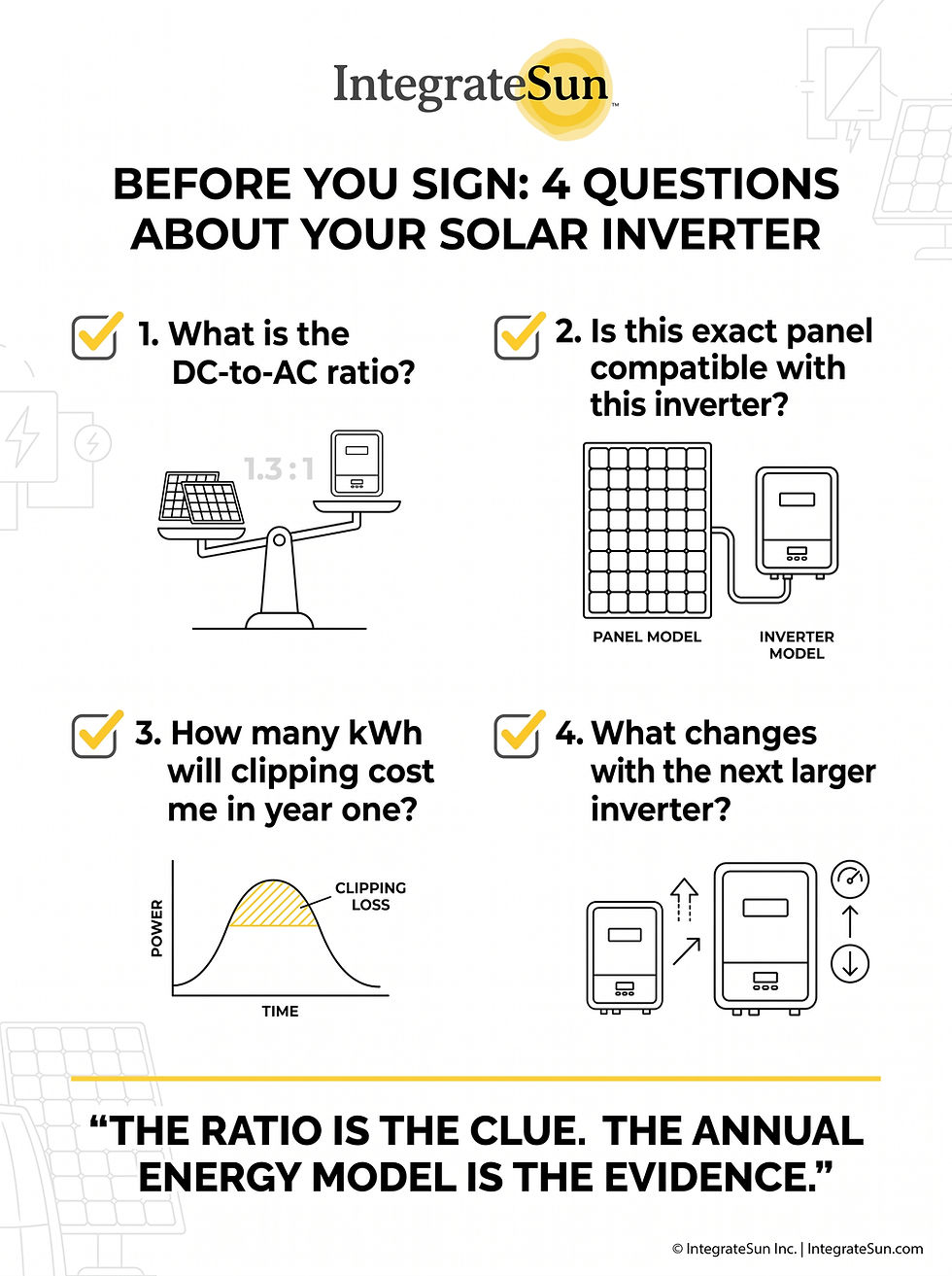
Ask these four questions:
1. What is the DC-to-AC ratio of this design?
They should be able to calculate it easily.
2. Is this exact panel electrically compatible with this exact inverter?
Ask for the manufacturer's compatibility documentation—not just reassurance.
3. How many kilowatt-hours do you expect to lose to inverter clipping in year one?
This is the number that matters.
4. What happens if we use the next larger appropriate inverter?
Ask for the difference in:
annual production
system price
estimated lifetime energy
estimated savings
A good design does not necessarily have zero clipping.
A good design has justifiable clipping.
So how can I tell if the inverter in my quote is actually undersized?
Do not reject a system merely because your panel says 430W and your microinverter says 290VA.
Instead, use that difference as a reason to investigate.
Calculate the DC-to-AC ratio.
Confirm electrical compatibility.
Then ask for the modeled annual clipping loss and compare it against the cost of the next appropriate inverter.
If the installer can show that a smaller inverter saves you meaningful upfront money while sacrificing very little annual energy, the design may be exactly right.
If the system is giving up a meaningful amount of production and the installer cannot show why the tradeoff makes financial sense, then you have something worth challenging before you sign.
The ratio is the clue. The annual energy model is the evidence.
Already have a solar proposal?
Send it to IntegrateSun for a free quote review. We'll check the panel-to-inverter pairing, system sizing, and production assumptions—and show you the numbers worth questioning before you sign.


