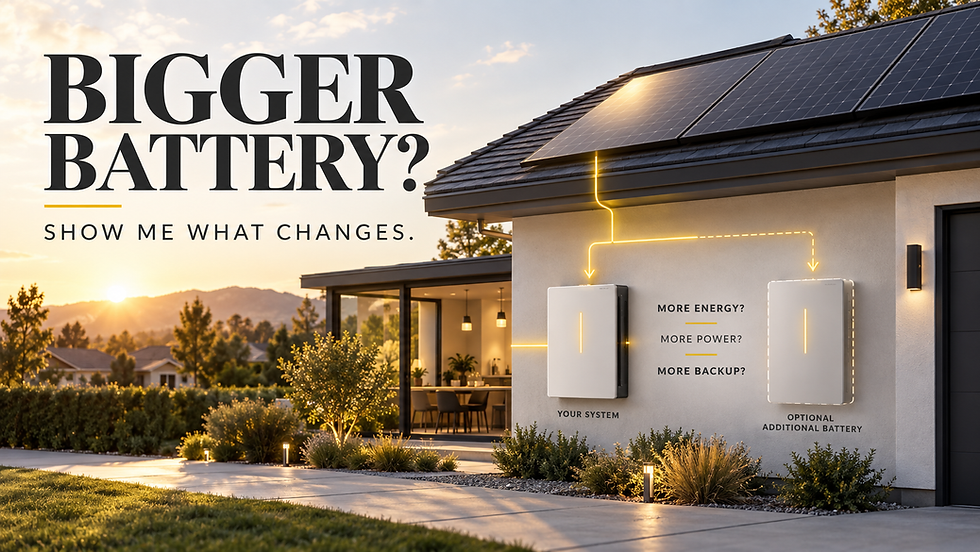
Tesla Powerwall 3 vs Enphase IQ Battery 5P: Which Battery Actually Fits Your Home?


Here's what nobody tells you when you're shopping for a home battery: the "best" battery isn't the one with the highest ratings; it's the one that matches how you actually use energy.
I've seen too many homeowners choose a battery based on what sounds impressive in a sales pitch, only to realize six months later that they picked wrong. One chose Tesla for the massive 13.5 kWh capacity, then discovered their single-phase limitation meant half their home went dark during outages. Another went with Enphase for the "safer" AC-coupled design, then got frustrated when they couldn't start their AC unit during a summer blackout.
So let's cut through the marketing and talk about what actually matters for YOUR situation.
The Actual Question You Should Be Asking
Most comparison articles obsess over specs, kilowatt-hours, efficiency percentages, and warranty years. But here's what matters more:
What happens when the grid goes down at 3 PM on a Tuesday in August?
Because that's when you'll find out if you made the right choice. Your AC is cranking, you're working from home, maybe running the dishwasher. Can your battery handle it? Or will you be manually shutting things off to avoid overloading the system?
Let me show you how these two batteries handle real-world scenarios differently.
Power vs. Capacity: What You Really Need to Know

Think of your battery like a water hose. Capacity (measured in kWh) is the size of your storage tank. Power output (measured in kW) is how fast water flows through the hose.
Tesla Powerwall 3:
Storage tank: 13.5 kWh
Flow rate: 11.5 kW continuous (can surge to 185 amps)
Translation: Massive tank, fire hose
Enphase IQ Battery 5P:
Storage tank: 5.0 kWh per unit
Flow rate: 3.2 kW continuous (27.8 amp peak)
Translation: Smaller tank, garden hose
Here's where this gets practical. That 185-amp surge capability on the Powerwall 3? That's what lets you start your central AC compressor, heat pump, or pool pump without the battery flinching. These are called "locked rotor amps"; the massive initial draw when a motor starts up.
A single Enphase 5P can't handle that surge. You'd need to stack multiple units to match that starting power. And here's the thing, most homeowners don't realize this until their first blackout, when their AC won't start, and they're scrambling to figure out why.
The Architecture Decision You Didn't Know You Were Making

This is where it gets interesting, and I'll keep it simple.
Tesla Powerwall 3 is a hybrid DC-coupled system. Your solar panels feed DC power directly into the battery unit, which has its own built-in inverter. Everything's in one box. Efficient, powerful, but there's a catch: if that central inverter fails, your entire system—both solar production and battery storage—goes offline.
Enphase is AC-coupled with microinverters. Each solar panel and each battery unit has its own tiny inverter. If one fails, the rest keep working. It's like having a backup generator with multiple engines instead of just one big one.
For most homeowners, Tesla's "all-in-one" approach is simpler and cheaper to install. But if you're the type who values redundancy—or if you have a three-phase electrical service—Enphase's distributed system might be worth the premium.
And speaking of three-phase: if your home has it (common in larger properties or homes with commercial-grade equipment), the Powerwall 3 can only backup ONE phase. Enphase can balance across all three. That's a dealbreaker for some premium homes.
The Actual Efficiency Story (Not What the Spec Sheets Say)

Both manufacturers will throw efficiency numbers at you. Tesla says 97.5% solar-to-grid efficiency. Enphase claims 90% round-trip efficiency.
But here's what actually happens in your home.
Every battery has what's called "tare loss"—the energy it uses just to stay awake and monitor itself. For Enphase, that's about 15 watts constantly. Doesn't sound like much, right? Over a month, that's about 10-11 kWh just... gone. Not powering your home, just keeping the lights on inside the battery.
When you factor in tare losses and the reality that most homes discharge their batteries slowly (300-500 watts for lights and small appliances at night), real-world efficiency drops. We're talking closer to 84-86% for Enphase in typical use.
The advantage Enphase has? Their app actually shows you these losses clearly. You can see exactly where your energy is going. Tesla and other manufacturers often hide tare losses in "home consumption," making it harder to track your true efficiency.
For energy nerds who want to optimize every kilowatt-hour, that transparency matters. For everyone else, just know that lab-tested efficiency ratings don't tell the whole story.
What Each Battery Does Best

Choose Tesla Powerwall 3 if:
You're installing NEW solar and battery together (the integrated design saves installation costs)
You need whole-home backup with heavy loads—central AC, electric heat, EV charging, pool equipment
You want the lowest upfront cost per kilowatt-hour stored (~$1,140/kWh vs. Enphase's ~$2,000/kWh)
You have a single-phase electrical service
You value simplicity—one box, one warranty, one point of contact
You want to connect massive solar arrays (the Powerwall 3 supports up to 20 kW of solar input)
Choose Enphase IQ Battery 5P if:
You already have Enphase microinverters on your roof (the integration is seamless)
You want to start small and scale up in 5 kWh increments as your budget allows
You have a three-phase electrical service that needs balanced backup
You value redundancy—no single point of failure
You want the longest warranty in the industry (15 years and 6,000 cycles vs. Tesla's 10 years)
Safety is your top priority (true rapid shutdown at the panel level, passive cooling with no fans)
The Hidden Cost Nobody Mentions
Here's where the Tesla vs. Enphase decision gets financially interesting.
Tesla wins on upfront cost, often coming in $8,000-$10,000 cheaper for equivalent storage capacity. If you need three Enphase 5P units (15 kWh total) to match one Powerwall 3 (13.5 kWh), you're looking at a significant price gap.
But Enphase's 15-year warranty is 50% longer than Tesla's 10-year coverage. And there's a throughput limit most people miss: Tesla's warranty caps out at 37.8 MWh over those 10 years. For a 13.5 kWh battery, that's roughly 2,800 full cycles.
If you're cycling your battery daily (common in states with time-of-use rates or VPP programs like we're seeing expand across Texas through ERCOT), you could hit that limit in 7-8 years, voiding your warranty before the 10-year term ends.
Enphase's 6,000-cycle limit gives you much more breathing room for heavy daily use.
What About Virtual Power Plants?
If you're in Texas, this matters. ERCOT's Virtual Power Plant programs are expanding rapidly, and homeowners are earning real money by letting the grid borrow power during peak demand.
Both batteries can participate in VPP programs, but there's a catch with Tesla: when you're selling power back to the grid at premium rates (we've seen $5/kWh during grid stress events), you're limited by Tesla's 5 kW battery charge power. Even though it can discharge at 11.5 kW, it can only charge at 5 kW. This is likely to preserve the LFP battery chemistry, but it means longer recharge times between VPP events.
Enphase's modular approach means you can scale your VPP capacity by adding more units, though you'll need multiple 5P batteries to match Tesla's single-unit discharge power.
The Bottom Line
Most homeowners shopping for batteries fall into one of two camps:
Camp 1: "I want maximum backup power for the lowest upfront cost." That's Tesla Powerwall 3. It's the workhorse. It'll start your AC, charge your EV, run your whole home during an outage, and cost you less to install. Just know you're putting all your eggs in one (very capable) basket.
Camp 2: "I want a system that'll last 15+ years with zero surprises." That's Enphase. You'll pay more upfront, but you're buying redundancy, transparency, and the longest warranty in residential solar. If one component fails, the rest keep working. If you want to add more capacity in five years, no problem.
There's no wrong choice here—just the wrong choice for YOUR situation.
How to Actually Decide
Here's what I recommend: don't start with the battery. Start with your goals.
Ask yourself:
What do I absolutely need to keep running during an outage? (Make a list—be specific)
Do I have three-phase power? (Check your main panel or call an electrician)
Am I installing solar and battery together, or adding a battery to existing solar?
What's my realistic budget for upfront costs vs. long-term value?
Do I plan to participate in VPP programs or time-of-use optimization?
Your answers will point you in the right direction.
Ready to size a battery system for your home? As a Tesla Powerwall certified installer with experience across both systems, we can run the numbers specific to your home's electrical service, your typical loads, and your backup priorities. We'll show you both options, including what each would cost and what each would actually power during an outage.
Book a free consultation, and we'll analyze your situation with zero pressure. Because the "best" battery is the one that matches how you actually live.