
Can a Powerwall 3 Run a Heat Pump All Winter?


A homeowner in Massachusetts just called me. His power went out at 9 PM during an ice storm. By 3 AM, his Tesla Powerwall hit zero. His brand-new heat pump shut off. He's standing in his kitchen in a bathrobe watching the temperature drop to 58 degrees.
His solar installer told him one Powerwall would handle everything. "Tesla batteries are amazing," they said. "You'll be totally fine."
That installer was wrong.
So can a Powerwall 3 run a heat pump all winter? The short answer is yes—but that's actually the wrong question. What you really need to ask is: how many Powerwalls do you need to keep YOUR heat pump running through YOUR coldest nights?
What Tesla Won't Tell You About Winter Usage

Tesla says the Powerwall 3 holds 13.5 kilowatt-hours and delivers 11.5 kilowatts of continuous power. Those are solid specs.
But here's the trap: those numbers mean nothing without context.
That Massachusetts home I mentioned? On a typical November day—not even December, just November—they used 45 kilowatt-hours. Some homes in New England hit 60 kilowatt-hours when it gets really cold. During a polar vortex in Colorado at negative 13 degrees, one home pulled 70 kilowatt-hours in a single day.
Now here's what trips people up: those are daily numbers. But your solar panels only work during the day. At night, you're 100% on battery.
Let's say the sun goes down at 5 PM and comes back up at 7 AM. That's 14 hours of darkness. If your home needs 60 kilowatt-hours per day in winter, somewhere between 30 to 40 of those kilowatt-hours are happening overnight while you're asleep.
One Powerwall 3: 13.5 kilowatt-hours.
You see the problem.
But it gets worse. Because your heat pump doesn't use power evenly throughout the night.
The Three Factors That Change Everything
Most installers size your battery based on your summer electric bill. That's insane. Here are the three factors they're ignoring:
Factor #1: Temperature Destroys Heat Pump Efficiency
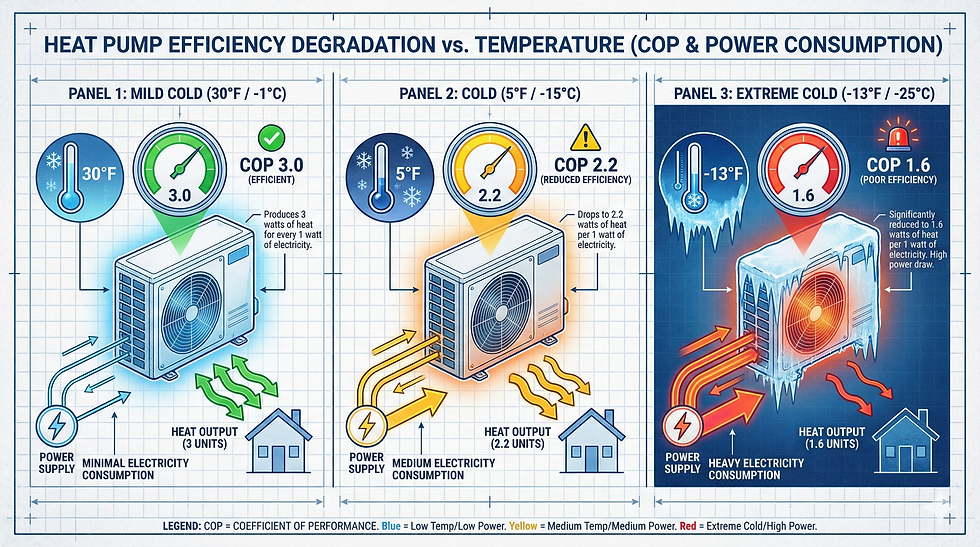
At 30 degrees, a good heat pump might have a COP—that's Coefficient of Performance—of 3.0. Meaning it produces three watts of heat for every one watt of electricity. Pretty efficient.
At 5 degrees? That same heat pump drops to a COP of 2.2.
At negative 13 degrees? Down to 1.6.
Same heat output. Wildly different electricity consumption. On a mild 30-degree night, your heat pump might pull 2 kilowatts. On a negative 10-degree night? Could be 5 kilowatts—over twice the power for the same amount of heat.
So when an installer says "one Powerwall will be fine," ask them: fine at what temperature?
Factor #2: Your Home's Insulation Matters More Than You Think
Two identical houses, same square footage, same heat pump. One is well-insulated, the other is drafty. The drafty house can use 75% more electricity to stay at the same temperature.
It's like filling a bathtub with the drain open. More insulation equals less battery drain. Simple as that.
Factor #3: You're Designing for the Wrong Scenario
Here's what's actually smart: you don't need to design your battery to handle the absolute coldest night of the century. You need to design it to handle the coldest night that's likely to coincide with a power outage.
In Massachusetts, the design temperature might be negative 5 degrees. But you know when the power actually goes out? During ice storms when it's 20 degrees. Or winter wind events when it's 15 degrees.
Huge difference. At 20 degrees, your heat pump is way more efficient. You might only need two Powerwalls instead of five.
The One Thing Powerwall 3 Does Better Than Everything Else
Quick technical sidebar: the Powerwall 3 has something called a Load Start Capability of 185 LRA. That's Locked Rotor Amps.
Why do you care? Because when your heat pump's compressor kicks on, it needs a massive surge of power—like 5 to 7 times its normal running current—for just a split second. Most batteries freak out and either fail to start the compressor or damage themselves trying.
The Powerwall 3 handles it without breaking a sweat. This is actually a huge deal that most people don't appreciate. A lot of battery systems simply can't reliably run heat pumps. The Powerwall 3 can.
How Many Powerwalls Do You Actually Need?
Let me give you a real example. Rochester, Minnesota. Design temperature: negative 12 degrees. That's seriously cold.
At that temperature, we tested different heat pump systems. The air-source heat pumps needed between 6 and 17 kilowatts of power just to keep up. One of them literally shut off—couldn't even run.
Over a 14-hour winter night at negative 12? You're looking at over 200 kilowatt-hours needed. That's 15 Powerwalls. Nobody's installing 15 Powerwalls.
But here's the thing: you're not designing for negative 12. You're designing for realistic outage scenarios—probably 15 to 20 degrees.
At 17 degrees, that same heat pump draws about 2.7 kilowatts. Over 14 hours, that's 38 kilowatt-hours just for heating. Add your fridge, lights, well pump—call it 45 kilowatt-hours total overnight.
Now we're talking three to four Powerwalls. That's actually doable.
And here's the smart move: for those once-a-decade extreme cold outages, keep a small propane heater as backup. It might run 10 hours per year total. But it means you're never truly without heat.
The Solar Problem Nobody Talks About

One more critical thing: can your solar panels even recharge your batteries in winter?
Because if you drain 45 kilowatt-hours overnight and can't fully recharge the next day, you're screwed on night two of an outage.
A 10-kilowatt solar system in Massachusetts might generate 25 kilowatt-hours on a sunny December day. Sounds good. But you're also running your house during the day—maybe another 15 kilowatt-hours.
So you generated 25, used 15 during the day, stored 10. But you needed to store 45 for tonight.
See the problem? You need a bigger solar array—probably 15 to 18 kilowatts—to fully recharge your batteries on the shortest winter days while also powering your house.
Most solar companies size your system to offset your annual usage. That's fine if you just want to save money on your bill. But if you want true backup power in winter, you need to size for the worst-case day—not the average year.
The Cheat Code Nobody Uses
Here's something wild: if you swap out your air-source heat pump for a ground-source heat pump, all these battery calculations get way easier.
Ground-source heat pumps pull heat from the earth—about 50 degrees year-round—instead of the freezing air. So even at negative 12 degrees outside, they maintain a COP of 3.5 or higher.
Same Rochester home, same negative 12-degree night. Ground-source system draws only 6 kilowatts instead of 16. Over 14 hours, that's 84 kilowatt-hours instead of 224.
Suddenly two or three Powerwalls work instead of four or five.
Now, ground-source costs way more upfront—sometimes double or triple. But if battery backup is your priority, the math might actually work in your favor because you need fewer batteries.
The Bottom Line: How Many Powerwalls Do You Really Need?
Can a Powerwall 3 run a heat pump all winter?
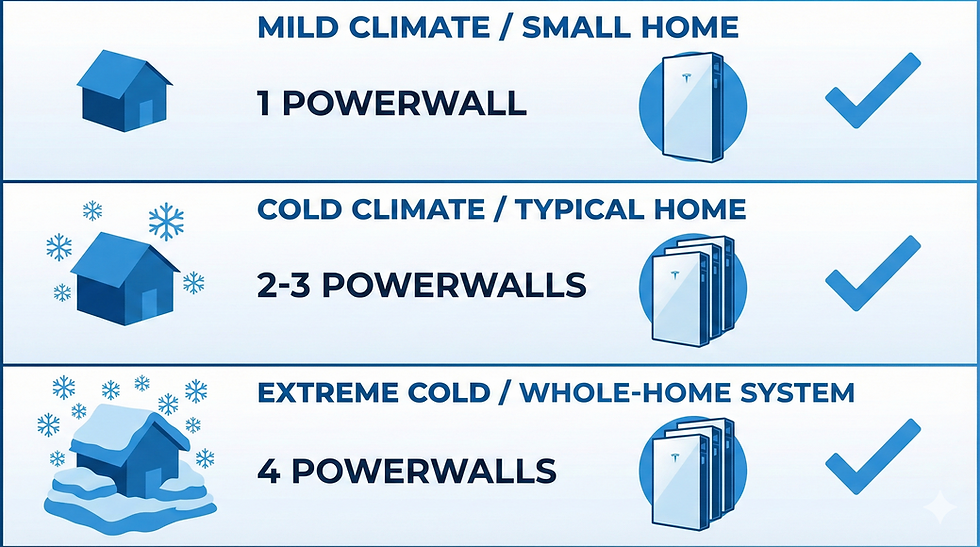
One Powerwall: Only if you have a tiny, super-efficient home in a mild climate.
Two to three Powerwalls: This'll handle most homes in cold climates during typical winter outages.
Four Powerwalls: Now you're bulletproof—even in extreme cold with a whole-home heat pump system.
But here's what actually matters: the system has to be designed right from day one. That means:
Getting a real heat loss calculation for your home—not a guess
Looking at your actual winter electricity bills—not averages
Sizing your solar to recharge those batteries on the shortest, cloudiest days—not just offset your annual usage
Most installers will sell you one Powerwall because it's easier. Then you end up like that Massachusetts homeowner—cold house, dead battery, 3 AM.
What You Should Do Next
If you're planning solar plus battery plus heat pump, do these three things:
First, get a professional heat loss calculation—it's called a Manual J. That tells you exactly how much heat you need at design temperature.
Second, look at your actual winter electric bills. Find your peak day in January or February. That's your battery sizing baseline.
Third, talk to someone who'll actually do the math. At IntegrateSun, we'll show you exactly how many Powerwalls you need based on your real data—not what's easiest to sell.
We'll walk through the overnight loads, the solar recharge scenarios, and what a properly sized system actually costs versus one that leaves you freezing.
This isn't about being perfect. It's about being prepared for what's actually likely to happen—with a backup plan for everything else.
Ready to design a system that actually works? Request a free system design review and we'll show you the real numbers for your home.


