
How Long Will a Powerwall Actually Last in a Blackout?


You want a straight answer to a simple question: if the power goes out, how long will a Tesla Powerwall keep your house running?
The annoying thing is, almost every answer you'll find online is some version of "it depends." Which is technically true and completely useless when you're trying to decide whether to spend fifteen thousand dollars.
So let's do something different. Let's actually answer it with real numbers. By the end of this, you'll be able to estimate your own runtime in about two minutes.
The One Number That Decides Everything

A Tesla Powerwall 3 holds 13.5 kilowatt-hours of usable energy. That's the size of the fuel tank.
But a fuel tank tells you nothing about range until you know how fast you're burning it. And this is exactly where the "it depends" comes from — not because the answer is unknowable, but because it depends entirely on how much power you're pulling at any given moment.
Think of it like your car. A full tank might last 400 miles on the highway or 200 miles towing a trailer uphill. Same tank. Wildly different range. Your Powerwall works the same way: the harder your house pulls, the faster it drains.
So the real question isn't "how long does a Powerwall last?" It's "how long does a Powerwall last running what I'm actually going to run?" Once you frame it that way, the math becomes simple.
Here's the formula, and it's the only one you need:
Battery size (13.5 kWh) ÷ what your home is drawing (in kW) = hours of runtime.
That's it. Let's put it to work with real scenarios.
Scenario 1: Riding Out an Outage on the Essentials
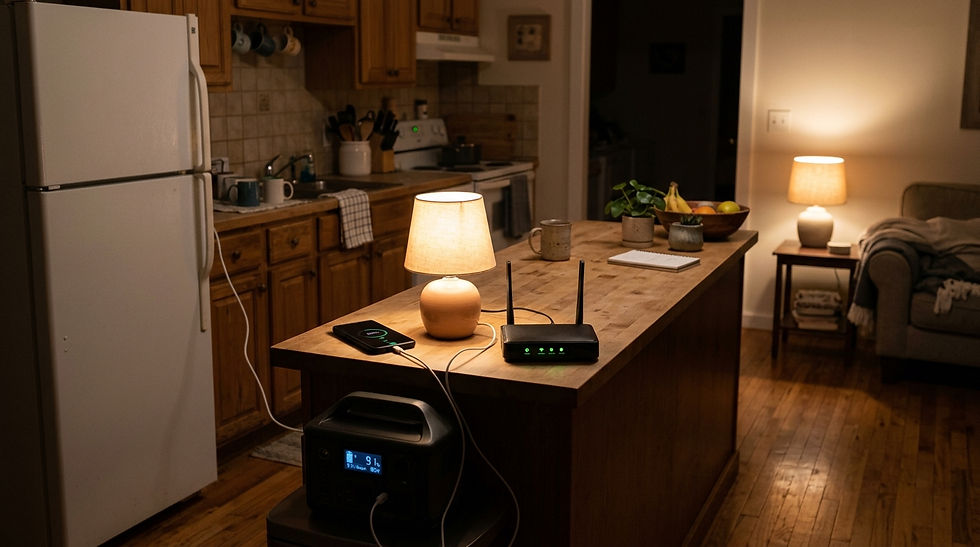
This is how most people actually use a battery during an outage — not running the whole house, just keeping the important stuff alive.
Picture your fridge, some lights, your Wi-Fi and phone chargers, and a few outlets. Realistically, that's pulling somewhere around 0.5 kW on average (appliances cycle on and off, so this is an average, not a constant).
Run the math: 13.5 ÷ 0.5 = 27 hours.
More than a full day on a single Powerwall, just on essentials. For the vast majority of outages — which are short — that's more than enough to never even notice the grid went down. This is the number the marketing wishes it could lead with, and in this scenario, it's real.
Scenario 2: Keeping Life Close to Normal
Now let's add the stuff that makes an outage tolerable rather than just survivable. Fridge, lights, Wi-Fi, plus a few bigger draws — maybe the microwave here and there, a TV, charging laptops, running the internet and home office.
That pushes your average draw to roughly 1.5 kW.
The math: 13.5 ÷ 1.5 = 9 hours.
Still enough to get through most overnight outages comfortably. You wake up, the grid's back, and the worst thing that happened was you didn't run the dryer.
Scenario 3: Trying to Run the Whole House (Here's Where It Breaks)

Now here's the scenario nobody selling you a battery wants to dwell on — and it's the one that causes the most buyer's remorse.
You decide you want everything running like nothing happened. Central AC in a Texas summer. Electric oven. Dryer. Maybe charging the EV. All at once.
Central air conditioning alone can pull 3 to 5 kW. Add an electric dryer (another 3–5 kW), an oven (2–3 kW), and now you're asking your house to draw 7 kW or more on a sustained basis.
The math: 13.5 ÷ 7 = under 2 hours.
Read that again, because it's the single most important sentence in this article. A brand-new $15,000 Powerwall, running your full home in a Texas summer, can be dead in under two hours. That's not a defect. That's physics. You're trying to pour a swimming pool through a garden hose.
This is the gap between what "whole-home backup" sounds like and what it actually delivers, and it's the number one reason homeowners feel misled after their first real outage.
If you're reading this because you're trying to figure out what your home would actually need, this is exactly the kind of thing worth talking through with someone before you buy. A free consultation with IntegrateSun will map your actual appliances to a real runtime estimate — no guessing, no sales fantasy. You can start that here and know your real number before you spend a dollar.
The Thing That Changes Everything: Solar

Everything above assumes your battery is running on its stored charge alone — a fixed fuel tank, draining down.
But if you have solar panels paired with your Powerwall, the equation transforms completely. During daylight, your panels aren't just powering your home — they're refilling the battery at the same time. You're burning fuel and refueling simultaneously.
In a sunny-daytime outage, a properly sized solar-plus-Powerwall system can run your essential loads indefinitely — the panels cover your usage and top off the battery during the day, and the battery carries you through the night. This is the difference between "my battery lasted 27 hours" and "we went four days without grid power and barely noticed."
This is why, for anyone serious about real outage resilience — not just riding out a short blip — solar isn't an add-on to the battery. It's the other half of the system. A battery alone is a countdown timer. A battery plus solar is a genuinely self-sustaining loop, as long as the sun keeps coming up.
So What's the Honest Answer?

If someone asks "how long will a Powerwall last in a blackout," the honest, useful answer is:
On essentials only: around a full day per Powerwall (27 hours in our example)
Keeping life mostly normal: most of a day (around 9 hours)
Running the entire house at once: possibly under 2 hours
With solar, in daylight, on reasonable loads: effectively indefinitely
The battery's fuel tank is fixed at 13.5 kWh. What you do with it is entirely up to how you size the system and how you use it during an outage.
And that's really the takeaway: the question isn't whether a Powerwall is "enough." It's whether your system is designed around how you actually intend to use it. A single Powerwall is plenty for a household that wants to keep the essentials running through storms. A household that wants true whole-home continuity in a hot climate needs more storage, more output, and almost certainly solar to go with it.
The homeowners who end up happy are the ones who knew their real number before they bought. The ones who end up disappointed are the ones who trusted the brochure.
Know Your Real Number
You don't have to guess at this. The math in this article gets you a rough estimate, but your actual runtime depends on your specific appliances, your climate, your usage habits, and whether solar is in the picture.
That's exactly what a free IntegrateSun consultation is for. We'll look at what you actually run, tell you honestly how many hours (or days) a given setup would give you, and design a system around your real life instead of a marketing fantasy. No pressure, no obligation — just your real number.
Because "it depends" is only a good answer if someone's willing to sit down and work out what it depends on. We are.


