Home EV Charger Installation: 5 Things to Know Before You Commit

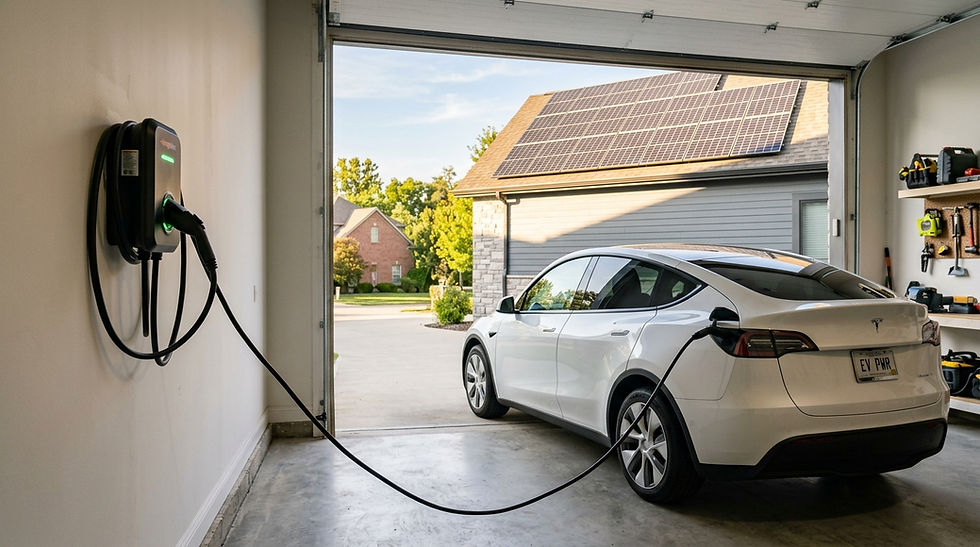
Every week, we talk to homeowners who just bought an EV, called an electrician to install a Level 2 charger, and got a number they weren't expecting.
Not because the electrician overcharged them. Because nobody told them what home EV charger installation actually involves — especially when solar is already in the picture.
Here are the five things that catch homeowners off guard every single time. Work through this list before you call anyone and you'll go into that conversation knowing exactly what you're dealing with.
1. Your Solar System Probably Wasn't Sized for a Car

If you already have solar and you're adding an EV, here's the first thing nobody mentions at the dealership.
Your solar system was almost certainly designed around your home's existing electricity use — not around a car you didn't own yet.
An average EV driven 12,000 miles a year adds approximately 3,600 kilowatt-hours of electricity consumption annually. To put that number in context — that's roughly 30 to 40 percent of what a typical American home consumes in an entire year. You're not adding a new appliance to your energy profile. You're adding something closer to a second home to your electric bill.
Research from 2026 shows that about 42 percent of residential solar systems installed before 2022 require either additional panels or electrical upgrades to support EV charging without increasing grid dependence. If your system was installed four or five years ago, there's nearly a coin-flip chance it isn't sized for what you're about to add.
The fix usually isn't dramatic — typically 6 to 10 additional panels covers the average commute — but it's a conversation worth having before you're three months into higher utility bills wondering why your solar system isn't keeping up anymore.
What to do: Pull up your solar monitoring app and look at your annual production versus consumption. If your system is already producing close to 100 percent of your home's usage, adding an EV will push you into a deficit. That gap needs to be planned for — either with additional panels or with a managed charging strategy that prioritizes daytime solar production.
2. Your Electrical Panel May Not Support It

About 20 percent of homes require some kind of electrical upgrade before a Level 2 EV charger can be safely installed. Most homeowners find this out when the electrician is already standing in front of their panel — after they've already budgeted only for the charger.
Here's the technical reason. A Level 2 charger requires a dedicated 240-volt circuit drawing 40 to 60 amps of continuous power. That load is roughly equivalent to adding another electric dryer to your home's electrical system on top of everything else already running.
If your panel is at or near capacity, or if it's an older 100-amp service, there may simply not be physical room for a new high-draw circuit. Panel upgrades run $2,000 to $5,000 depending on your home, location, and the extent of the work required. That's a meaningful budget item that belongs in your planning from day one — not a surprise you discover mid-project.
A few warning signs worth knowing before you call an installer: flickering lights when large appliances cycle on, breakers that trip frequently, or a panel from a recalled brand like Zinsco or Federal Pacific. Any of these suggest your panel needs attention before adding a significant new load.
What to do: Before committing to a charger, ask your installer to assess your panel capacity. A 30-minute evaluation tells you whether you're ready to go or whether there's an upgrade cost you need to factor in. This one conversation saves a lot of mid-project surprises.
3. DIY Installation Is Now Effectively a Code Violation in Most States
This change is recent — and most homeowners haven't heard about it yet.
The 2026 National Electrical Code, finalized in August 2025, now requires that permanently installed EV charging equipment be installed by a licensed electrician. State-by-state adoption is rolling out through 2026 and into 2027. In states that have adopted the updated code, a homeowner who buys a Level 2 charger and wires it themselves is technically in violation — with no permit, no inspection, and no paper trail.
Professional installation runs $1,500 to $3,500 nationally depending on your location and the complexity of the work. That's a real line item that belongs in your budget from the start rather than something you plan to avoid.
This isn't entirely bad news. Licensed, permitted installation protects your homeowner's insurance coverage — an unpermitted electrical installation can be grounds for a denied claim if something goes wrong. It also creates the documentation that matters when you eventually sell your home. But it does mean the DIY shortcut that used to be an option is largely off the table now.
What to do: Budget for professional installation from day one. Get quotes from at least two licensed electricians and confirm that the installation will be permitted and inspected. Ask specifically whether your state has adopted the 2026 NEC — the answer affects what's required and what's optional.
4. Your EV May Limit What Your Charger Can Do

Not all EVs accept the same charging speed — and this directly affects which charger actually makes sense for your home.
Most modern EVs accept up to 11 kilowatts of AC charging through a Level 2 charger. But some older or budget-oriented models have onboard chargers capped at 6.6 kilowatts — or even 3.3 kilowatts. Installing an 11-kilowatt charger on a car that can only accept 6.6 kilowatts doesn't deliver faster charging. It means you paid for capacity your car physically cannot use.
This spec — your EV's onboard charger rating — is one of the most important factors in determining which hardware is right for your home. It's also one that most charger salespeople never bring up, because the higher-capacity charger costs more and the customer rarely knows to ask.
What to do: Before specifying any charger hardware, find your EV's onboard charger rating in the owner's manual or on the manufacturer's website. Match your charger capacity to what your car can actually accept. If you plan to buy a second EV in the next few years, factor that into the conversation — a charger sized for your current car may be undersized for a future one.
5. There May Be a Financial Credit Worth Checking

One financial consideration worth knowing — though it comes with an honest caveat.
The Section 30C Alternative Fuel Vehicle Refueling Property Credit covers 30 percent of your EV charger and installation cost, up to $1,000 for residential installations. On a typical installed charger running $2,000 to $3,500, that's a meaningful reduction in out-of-pocket cost.
The caveat: this credit has a location requirement that most content on this topic skips over. To qualify, the property where the charger is installed must be located in a low-income community or a rural — meaning non-urban — census tract. If you're in a suburban or urban area, you may not be eligible regardless of when you install. Not every home qualifies, and assuming you do without checking first leads to a tax filing surprise you'd rather avoid.
What to do: Before assuming you qualify, go to the Department of Energy's Alternative Fuels Station Locator and enter your address to check your census tract status. It takes about two minutes and gives you a definitive answer before you factor the credit into your budget.
The Honest Bottom Line
Home EV charger installation is straightforward when you go in prepared. The surprises that blindside homeowners — undersized solar systems, panel capacity limits, professional installation requirements, charger compatibility mismatches, and tax credit eligibility assumptions — are all avoidable with the right conversations upfront.
Work through these five points before you call anyone. They take less than an hour to check and will save you from discovering mid-project costs that should have been in your budget from day one.
If you want someone to look at your specific situation — your solar system, your panel, your EV model, and whether your property qualifies for available credits — that's exactly what our free consultation covers. We'll tell you what your home actually needs and what it will realistically cost.