Cheap Solar Panels vs Premium Panels: What You Actually Get for the Price Difference


Here's the question that comes up on almost every consultation we run.
"Is there actually a meaningful difference between a $2.50 per watt panel and a $4.20 per watt panel — or am I just paying for a brand name?"
It's a fair question. And the honest answer is: it depends on your situation.
Cheap solar panels are not always a bad deal. There are real scenarios where a budget panel makes complete financial sense and a homeowner who buys premium is simply overpaying for performance they'll never fully capture.
But cheap panels are a bad deal in more situations than most homeowners realize. The gap between what they think they're saving upfront and what they're actually losing over 25 years is one of the most consistent mistakes we see across 12 states.
This post runs the real math on both sides. Three situations where a budget panel is genuinely the right call. Four situations where the premium pays for itself — with specific numbers. And the brands we actually recommend across each tier after 7,000+ installations.
The Real Difference Between Cheap and Premium Panels
Before the scenarios, here's the fundamental difference between a cheap panel and a premium one — because it's not primarily about the efficiency number on the spec sheet.
The real difference is degradation rate.
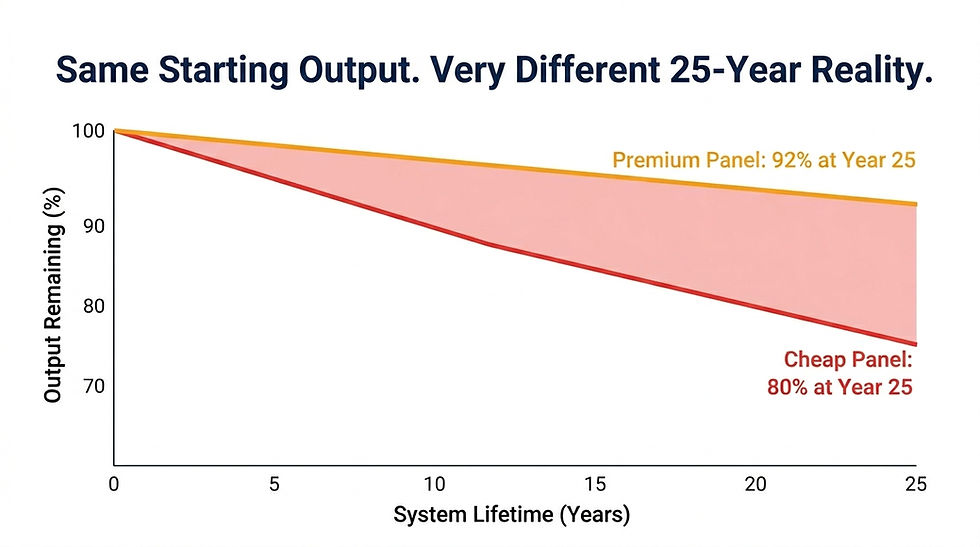
Every solar panel loses a small percentage of its output every year as the cells age. Premium panels from tier-one manufacturers degrade at roughly 0.3 to 0.5 percent per year. Cheap import panels degrade at 0.8 to 1.5 percent per year — sometimes higher.
A premium panel guaranteed at 92% output at year 25 is still producing nearly what it did on day one. A cheap panel guaranteed at only 80% output at year 25 has lost a fifth of its production capacity before its warranty expires. And unlike a fraudulent efficiency rating on a spec sheet, the degradation rate is something a manufacturer can't hide indefinitely — it shows up in monitoring data within three to five years.
Everything else — efficiency rating, temperature coefficient, warranty terms — flows from the same root cause: manufacturing quality. Premium panels are built with better cell technology, tighter quality control, and better materials. Cheap panels aren't. That's the whole story.
What to look for: Pull the linear power warranty from any spec sheet you're evaluating. It should guarantee at least 90% output at year 25 for a tier-one panel. Anything below 85% should prompt serious questions before you commit.
3 Situations Where Cheap Panels Are Genuinely Fine

Let's start with the honest case for budget panels — because it exists.
Situation 1: You have unlimited roof space and modest energy needs.
Panel efficiency matters most when roof space is the limiting factor. If you have a large, mostly unshaded roof with room for 30 or 40 panels, you can achieve the same total output with cheaper lower-efficiency panels as you would with fewer premium ones. The efficiency advantage disappears when space isn't a constraint. In this situation cost per watt is the right metric — not efficiency rating — and a verified mid-tier panel at $2.50 to $3.00 per watt is a legitimate choice.
Situation 2: Short time horizon.
Premium panels earn their premium over 20 to 25 years of compounding production advantage. If you're planning to sell your home within five to seven years, paying 40 to 70 percent more per watt for a long-term benefit you won't be around to capture is hard to justify. A well-priced mid-tier panel from a verified manufacturer makes more financial sense in this scenario.
Situation 3: Tight budget in a low electricity rate market.
If your utility rate is under 10 cents per kilowatt-hour, the financial gap between premium and budget narrows significantly because the value of each additional kilowatt-hour produced is lower. In these markets a reasonably priced mid-tier panel from a verified manufacturer often delivers better overall value than premium.
The critical caveat across all three scenarios: The word "cheap" here means verified mid-tier — not unverified import. A budget panel from a legitimate manufacturer with real certifications and an honest degradation guarantee is a legitimate choice in the right situation. A panel from an unverified importer with a fraudulent efficiency claim is never the right choice regardless of price. Before buying any budget panel, verify the manufacturer through PVEL and RETC, confirm the UL or IEC certification number searches correctly, and read the linear power warranty. If any of those checks fail, walk away regardless of the price.
4 Situations Where Premium Pays for Itself
Now the four situations where the additional cost is consistently justified — with the numbers to back it up.
Situation 1: Limited Roof Space
This is the clearest case for premium. If your usable roof area limits you to 15 or 20 panels, every percentage point of efficiency is worth real money because you simply can't add more panels to compensate for lower output per panel.
A QCells Q.PEAK DUO series panel at 21.4% efficiency versus a SunPower Maxeon 7 at 24.1% efficiency on the same 20-panel roof produces meaningfully different energy output every single day for 25 years. When space is the binding constraint, buy the best efficiency your budget can support.
What to do: If your installer's proposal is limited by roof space rather than energy needs, ask specifically about premium efficiency options. The upfront cost difference is often recovered in additional production within five to seven years.
Situation 2: Hot Climate
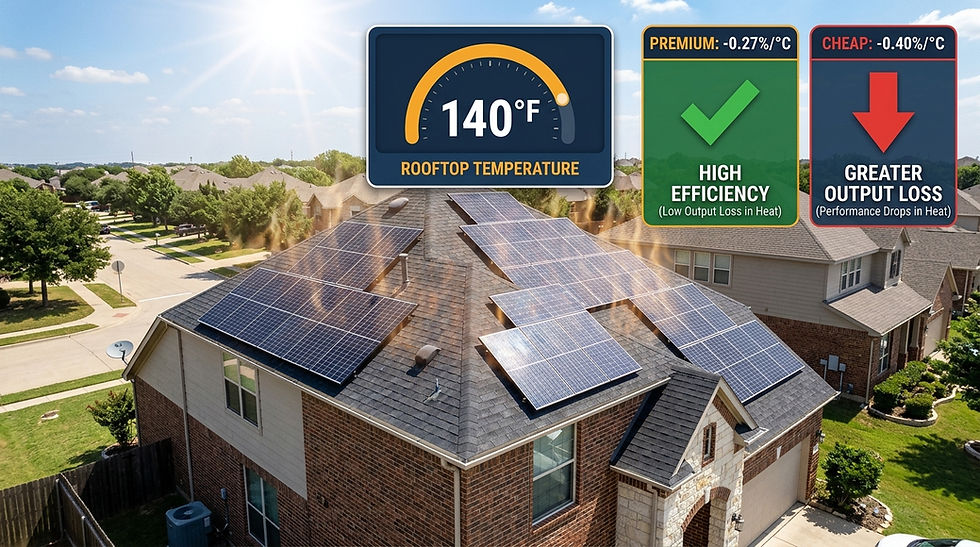
If you're in Texas, Arizona, Florida, or Southern California, the temperature coefficient gap between a cheap panel and a premium one is one of the most underappreciated performance factors in residential solar — and one of the most financially significant.
Premium N-type panels — TOPCon and HJT technology — offer temperature coefficients of -0.26% to -0.30% per degree Celsius. Cheap panels cluster at -0.35% to -0.40%. On a Texas rooftop hitting 140 degrees Fahrenheit in August — roughly 60 degrees Celsius above the standard test baseline — that gap translates to 6 to 8 percentage points of output difference on your hottest sunniest days. Those are exactly the days your system should be performing at its best.
Over a 25-year system life in a hot climate, the temperature coefficient gap alone accounts for thousands of kilowatt-hours of missed production. In a high-rate electricity market like California, that missed production has real dollar value every single month.
What to do: Check the temperature coefficient on any panel spec sheet before comparing efficiency ratings. For Texas, Arizona, Florida, and California installations, prioritize panels with coefficients of -0.30% or better. Cheap panels that don't publish this number prominently are hiding it for a reason.
Situation 3: Long Time Horizon — The $7,785 Number

Here's the figure that puts the premium vs. budget decision in concrete terms.
A 24% efficient premium system generates approximately $7,785 more in net energy savings over 25 years compared to a standard 21% efficient system of the same size at average US electricity rates. In high-rate markets — California peak rates hitting 40 to 70 cents per kilowatt-hour — that gap grows significantly larger.
The premium system costs roughly $2,000 to $4,000 more upfront. The return on that premium investment — $7,785 in additional energy savings — means you're recovering two to four times what you paid extra over the system's lifetime. That's a compelling ROI that most homeowners never see because they're comparing upfront sticker prices rather than lifetime energy value.
Now layer in degradation on top of efficiency. A premium panel degrading at 0.4% per year versus a budget panel degrading at 0.8% per year on identical 10 kWh per day starting systems:
Year | Premium Panel Output | Budget Panel Output | Daily Gap |
Year 1 | 10.0 kWh | 10.0 kWh | 0 |
Year 10 | 9.64 kWh | 9.28 kWh | 0.36 kWh |
Year 20 | 9.24 kWh | 8.56 kWh | 0.68 kWh |
Year 25 | 9.04 kWh | 8.20 kWh | 0.84 kWh |
That daily gap compounds over 25 years into tens of thousands of kilowatt-hours of additional production from the premium panel. At 20 cents per kilowatt-hour that's thousands of dollars in energy value the budget panel simply never delivers.
What to do: When comparing proposals, ask your installer to show you the projected lifetime energy production for each panel option — not just the year-one estimate. The lifetime production difference between a 0.4% and 0.8% degradation panel is almost never shown proactively. Ask for it.
Situation 4: You Want a Warranty That Actually Means Something
Premium manufacturers back their panels fundamentally differently than budget ones — and the details matter more than most homeowners realize.
Most standard solar warranties cover the panel itself but not the labor to remove and reinstall it if a panel fails and needs replacing. On a rooftop installation that labor cost runs $200 to $500 per panel. REC's ProTrust warranty — available through certified installers — covers 25 years of product, performance, and labor. That labor coverage eliminates a hidden cost that catches most homeowners off guard when they actually need to make a warranty claim.
SunPower Maxeon offers a 40-year comprehensive warranty — the longest in the residential market by a significant margin. QCells' Q.Protect program provides a similar full-system warranty through certified installers.
Warranty claim success rates vary from 85 to 98 percent depending on manufacturer financial stability. A warranty from a company with a 30-year operating history and strong financial position is a fundamentally different asset than one from a company founded three years ago with no track record. The paper looks the same. The practical protection is completely different.
Brand Recommendations: What We Actually Install

Here's where we land after 7,000+ installations across 12 states and every panel tier.
SunPower Maxeon 7 — Maximum performance 24.1% efficiency. 40-year comprehensive warranty. The best temperature coefficient in the residential market at -0.27% per degree Celsius. The right choice for limited roof space, hot climates, and homeowners who want the highest lifetime production from their system. Premium pricing at $4.00 to $4.20 per watt reflects genuine performance — not just a brand name.
REC Alpha Pure — Best value in the premium tier 22.6% efficiency. ProTrust warranty with 25-year labor coverage through certified installers. Strong manufacturer financial backing. Pricing runs 20 to 30 percent below Maxeon while delivering genuinely premium cell technology and degradation performance. The panel we recommend most often for homeowners who want tier-one quality without the absolute top-of-market price tag.
QCells Q.PEAK DUO series — Mid-tier sweet spot 21 to 22% efficiency. Manufactured in Georgia. Q.Protect warranty program through certified installers. Proven track record across millions of installations with consistent PVEL and RETC performance rankings. The right choice for homeowners with adequate roof space who want verified quality at a competitive price point — typically $2.85 to $3.20 per watt installed.
LONGi Hi-MO X series — Cutting-edge efficiency at competitive pricing 23 to 24% efficiency using advanced back-contact cell architecture. The world's largest solar manufacturer by volume with a strong independent testing track record. Delivers premium cell technology at pricing that undercuts comparable Western brands. The right choice for efficiency-focused buyers who want top-tier performance without the Maxeon price premium.
What we don't install: Unverified import panels from manufacturers with no PVEL or RETC history, no searchable certifications, and degradation guarantees below 85% at year 25. The upfront savings are not worth the 25-year exposure regardless of what the spec sheet claims.
The Decision Framework
Here's the complete decision in plain terms before you call anyone:
Buy budget if: You have unlimited roof space, a short time horizon of under seven years, and a low electricity rate under 10 cents per kilowatt-hour — and you've verified the manufacturer through PVEL, RETC, and the UL certification database.
Buy premium if: Your roof space is limited, you're in a hot climate, you're planning to stay in the home long-term, or you want warranty coverage with genuine financial backing. The math consistently supports premium in all four of these situations.
The brands we trust across each tier: SunPower Maxeon for maximum performance, REC Alpha for best premium value, QCells for mid-tier reliability, LONGi for cutting-edge efficiency at competitive pricing.
The panels we avoid: Anything from a manufacturer you can't verify in PVEL or RETC with a certification number that doesn't search, or a degradation guarantee below 85% at year 25.
Get a Free Consultation
If you're comparing proposals and want someone to tell you honestly which panel tier makes the most sense for your specific roof, climate, and time horizon — that's exactly what our free consultation covers.
We install across every tier. We don't have a financial incentive to push you toward premium if budget makes more sense for your situation. We'll tell you what's right for your home and show you the lifetime production numbers for each option side by side.