Tesla Powerwall 3 vs Enphase 10C: Which Home Battery Actually Fits Your Setup?


You're buying a home battery. You've narrowed it down to Tesla Powerwall 3 or Enphase IQ Battery 10C. And now you want to know which one's better.
Here's the truth: neither one is universally "better." They're engineered for completely different scenarios. Pick the wrong one for your setup, and you just wasted $15,000-$20,000.
This isn't a fanboy post. We install both systems at IntegrateSun. We're Tesla Powerwall Certified. We're Enphase partners. We don't care which one you buy—we care that you pick the right one for YOUR house.
Let's break down the four differences that actually matter.
1. Power Output: Can You Actually Back Up Your Whole House?

First critical difference: how much power each battery can deliver at once.
Spec | Tesla Powerwall 3 | Enphase IQ Battery 10C |
Continuous Power | 11.5 kW | 7.08 kW |
Continuous Amps (240V) | 48 A | 29.5 A |
Surge Capacity | 185 LRA (<1 sec) | 90 LRA (sustained 2 sec) |
What this means in plain English:
The Powerwall 3 delivers 60% more continuous power than a single Enphase battery. That's not a small difference.
Real-World Impact:
With one Tesla Powerwall 3:You can back up your entire house—central AC, electric range, well pump, washer, dryer—for about 95% of American single-family homes. Flip the main breaker during an outage, whole house stays on.
With one Enphase 10C:You're picking and choosing. Fridge, lights, internet, a few outlets? Yeah. Central AC and electric dryer running simultaneously? Probably not. Most whole-home backup scenarios require 2-3 Enphase batteries.
Surge Capacity (Starting Motors):
The Powerwall's 185 LRA can start most residential AC units up to 5 tons. But it's a very brief surge (under 1 second).
The Enphase 10C's 90 LRA is lower, but it sustains that surge for 2 full seconds using Power Start™ technology. For high-inrush motors (common in Florida homes with older AC units), that sustained surge matters more than peak numbers.
Bottom line: Tesla gives you whole-home backup with one unit. Enphase makes you strategic about what you're backing up—or you're buying multiple batteries, which changes the math fast.
2. System Architecture: How They're Built Matters
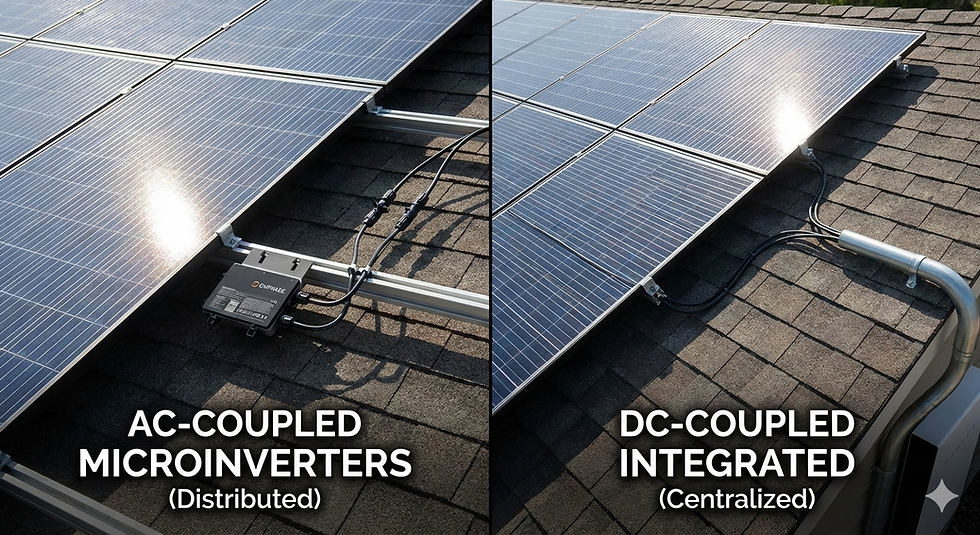
This is the most fundamental difference, and it determines compatibility with your existing (or future) solar system.
Tesla Powerwall 3: DC-Coupled Integrated System
The Powerwall 3 is a DC-coupled system with an integrated hybrid inverter. One box handles both your solar panels (DC power) and your battery storage.
Key features:
6 MPPTs (Maximum Power Point Trackers) for complex roof designs
Higher round-trip efficiency (solar → battery → home)
Simpler installation (fewer components)
Slimmer physical profile (8 inches deep)
Best for: New solar-plus-storage installations where you're starting from scratch.
Enphase 10C: AC-Coupled Microinverter System
The Enphase 10C is an AC-coupled system designed exclusively for Enphase microinverters—those small inverters installed under each solar panel.
Key features:
Works seamlessly with existing Enphase solar systems
Each solar panel operates independently (maximum production on complex/shaded roofs)
Distributed architecture (no single point of failure)
Thicker physical profile (14+ inches deep)
Best for: Homes that already have Enphase microinverters, or new systems on complex roofs with shading.
Can You Mix and Match?
Adding Powerwall to existing Enphase solar: Technically yes, but you're AC-coupling it, which means you lose the DC-coupled efficiency advantage. You're also mixing two different ecosystems. Not ideal.
Adding Enphase battery to existing string inverter solar: No. The Enphase 10C fundamentally requires Enphase microinverters. It won't work with a traditional string inverter setup.
The Reliability Trade-Off:
Enphase's distributed architecture means if one microinverter fails (whether in a solar panel or inside the battery), the rest of the system keeps running. No single point of failure.
Tesla's integrated inverter is robust, but it's one critical component. If that inverter fails, your entire system—solar production AND battery backup—goes down until Tesla sends a technician to replace the 300+ pound unit.
Serviceability: Enphase batteries allow on-site component swaps. Powerwall failures often require full unit replacement with extended downtime.
3. Capacity & Scalability: How You Expand Later
Storage Capacity Per Unit:

Tesla Powerwall 3: 13.5 kWh usableEnphase 10C: 10 kWh usable
Tesla gives you 35% more storage per battery.
Scalability Strategies (This Is Critical):
Tesla's approach:
Stack up to 4 full Powerwall 3 units (54 kWh total, 192A continuous power)
OR add cheaper "Expansion Units" that add storage (kWh) WITHOUT adding power (kW)
Maximum system: 94.5 kWh
Why this matters: If you're happy with your power output and just want longer outage runtime, Tesla's expansion units are cost-effective. You're only paying for "gas tank size," not "engine horsepower."
Enphase's approach:
Stack up to 8 batteries (80 kWh total)
Every battery includes its own microinverters
Both storage (kWh) AND power (kW) scale together
Why this matters: If you think you might add an EV charger, heat pump, or other high-draw loads in the future, Enphase ensures your system can handle it. You're scaling both "gas tank" and "horsepower" simultaneously.
Which Strategy Is Better?
Choose Tesla's model if: You're satisfied with current power needs and just want more backup hours.
Choose Enphase's model if: Your future energy needs might increase (new EV, heat pump, home addition).
4. Warranties, Ecosystem, and the Stuff That Actually Matters Daily

Warranty Comparison:
Warranty Aspect | Tesla Powerwall 3 | Enphase 10C |
Battery Term | 10 years | 15 years or 6,000 cycles |
Cycles | Unlimited | 6,000 cycles |
Capacity Retention | ≥70% | ≥60% |
Inverter | 10 years (integrated) | 25 years (microinverters) |
The trade-off:Enphase gives you longer coverage (especially on inverters—25 years vs 10). Tesla gives you operational flexibility with unlimited cycles.
For most homeowners, Enphase's 15-year battery warranty and 25-year microinverter warranty provide significantly more long-term peace of mind.
Generator Integration (Critical for Hurricane/Wildfire Zones):
Enphase: The IQ Combiner 6C has a dedicated generator input. Plug in your generator during extended outages, and it can both power your home AND recharge your batteries. This is huge for Florida hurricane season or California wildfire power shutoffs.
Tesla: A generator can power your home alongside the Powerwall, but it cannot recharge the battery. You need an external transfer switch, and even then, it's not designed for this use case.
If you live in an area with multi-day outages, this alone might decide it for you.
EV Charging Integration:
Tesla: If you own a Tesla vehicle, the integration is seamless. The Tesla app shows your home energy, battery status, AND vehicle charging—all in one place. It's slick.
Enphase: They make an IQ EV Charger, but the software integration with your actual vehicle isn't as deep.
If you're in the Tesla ecosystem (car + Powerwall), the unified experience is a real advantage.
Fault Handling:
Enphase: If you overload the system, it automatically resets itself once the load is reduced. No manual intervention needed.
Tesla: Overload situations may require you to manually reset breakers. For non-technical homeowners, this is a meaningful usability difference.
The Physical Stuff That Matters
Size and Installation:
Tesla Powerwall 3: 8 inches deepEnphase 10C: 14+ inches deep
Why this matters: That 6-inch difference is huge for tight spaces. The Powerwall fits on garage side walls and narrow walkways where the bulkier Enphase unit might violate local building codes for walkway clearance.
Installation Cost Factors:
Both systems now support meter socket adapters (MSAs):
Enphase IQ Meter Collar
Tesla Backup Switch
These streamline whole-home backup by eliminating the need for a critical loads subpanel, potentially saving $2,500-$3,500 in labor costs.
Other cost variables:
Main panel upgrade (if needed): $3,500-$5,500
Long wire runs: Increases material costs
Permit fees: Vary by location
The 10% Domestic Content Adder (Big Deal):
Both systems qualify for the 30% Federal Clean Energy Credit. But here's a significant differentiator:
Enphase qualifies for the additional 10% Domestic Content Adder (DCA) tax credit.Tesla does not (as of January 2026).
On a $60,000 solar + battery project:
Standard 30% credit: $18,000 savings
Enphase with 40% total (30% + 10% DCA): $24,000 savings
That's an extra $6,000 in your pocket with Enphase. For budget-conscious buyers, this tips the scales.
So Which Battery Should YOU Buy?
Here's the decision framework:
Buy the Tesla Powerwall 3 if:
You want whole-home backup with a single battery
You're building a NEW solar-plus-battery system from scratch
You own a Tesla vehicle (or plan to)
You have limited wall space (8-inch depth vs 14-inch)
You prioritize maximum power output per unit
You value the integrated, streamlined design
Buy the Enphase 10C if:
You already have Enphase microinverter solar
You need generator integration for extended outages
You have a complex roof with shading issues
You value system reliability (no single point of failure)
You want longer warranty coverage (15 years + 25-year microinverters)
You qualify for the 10% Domestic Content Adder ($6K extra savings)
You might add high-power loads later (EV, heat pump) and want power to scale with capacity
The Honest Take: Neither One Is "Wrong"
Look, both of these are premium batteries. Tesla and Enphase are the two most reputable names in residential energy storage for a reason.
You're not making a bad choice with either one.
But you ARE making a $15,000-$20,000 decision. And that decision should be based on:
What solar system you have (or plan to install)
What you actually want to back up during outages
Whether you need generator integration
Your long-term energy plans (EVs, heat pumps, additions)
Your physical installation constraints
Don't pick based on brand loyalty. Pick based on what actually works for your house.
Get an Honest Assessment
At IntegrateSun, we're Tesla Powerwall Certified AND Enphase partners. We install both systems across 12 states. We literally don't care which one you buy—we just want you to pick the right one.
We offer free battery assessments where we'll discuss with you which battery makes sense for YOUR situation.
Quick Reference: Side-by-Side Specs
Feature | Tesla Powerwall 3 | Enphase 10C |
Power Output | 11.5 kW (48A) | 7.08 kW (29.5A) |
Energy Capacity | 13.5 kWh | 10 kWh |
Surge Capacity | 185 LRA (<1 sec) | 90 LRA (2 sec sustained) |
Architecture | DC-coupled, integrated | AC-coupled, microinverters |
Warranty | 10 years, unlimited cycles | 15 years or 6,000 cycles |
Inverter Warranty | 10 years | 25 years |
Depth | 8 inches | 14+ inches |
Max System Size | 4 units + expansions (94.5 kWh) | 8 units (80 kWh) |
Generator Recharge | No (requires external switch) | Yes (built-in input) |
EV Integration | Seamless (Tesla vehicles) | Basic (IQ Charger) |
Domestic Content Credit | No | Yes (+10% tax credit) |
Typical Cost (Installed) | $13K-$16K per unit | $12K-$15K per unit |
Frequently Asked Questions
Q: Can I add a Powerwall 3 to my existing Enphase solar system?
Yes, but you lose the DC-coupled efficiency advantage. If you already have Enphase microinverters, the Enphase battery usually makes more sense for seamless integration.
Q: Which one is more reliable long-term?
Enphase's distributed architecture has no single point of failure—if one microinverter dies, the rest keeps running. Tesla's integrated inverter is simpler but represents a critical single component. Both are reliable in practice.
Q: Can I backup my entire house with one battery?
1 Powerwall 3: Yes, for ~95% of American homes
1 Enphase 10C: Usually need 2-3 batteries for true whole-home backup
Q: What if I want to add more batteries later?
Both support expansion. Tesla's expansion units add storage without adding power (cheaper). Enphase batteries add both storage and power when you scale (better for growing energy needs).
Q: Which warranty is actually better?
Enphase: 15-year battery + 25-year microinverters (longer coverage)Tesla: 10-year battery with unlimited cycles (operational flexibility)
For most homeowners, Enphase's longer warranty provides more peace of mind.
About IntegrateSun: We're a Tesla Powerwall Certified installer and Enphase partner with 7,000+ installations across Texas, California, Arizona, Florida, Georgia, Colorado, Nevada, Pennsylvania, Maryland, South Carolina, Oklahoma, and Washington DC. We install BOTH systems because we're not loyal to brands—we're loyal to what works for your specific home.